
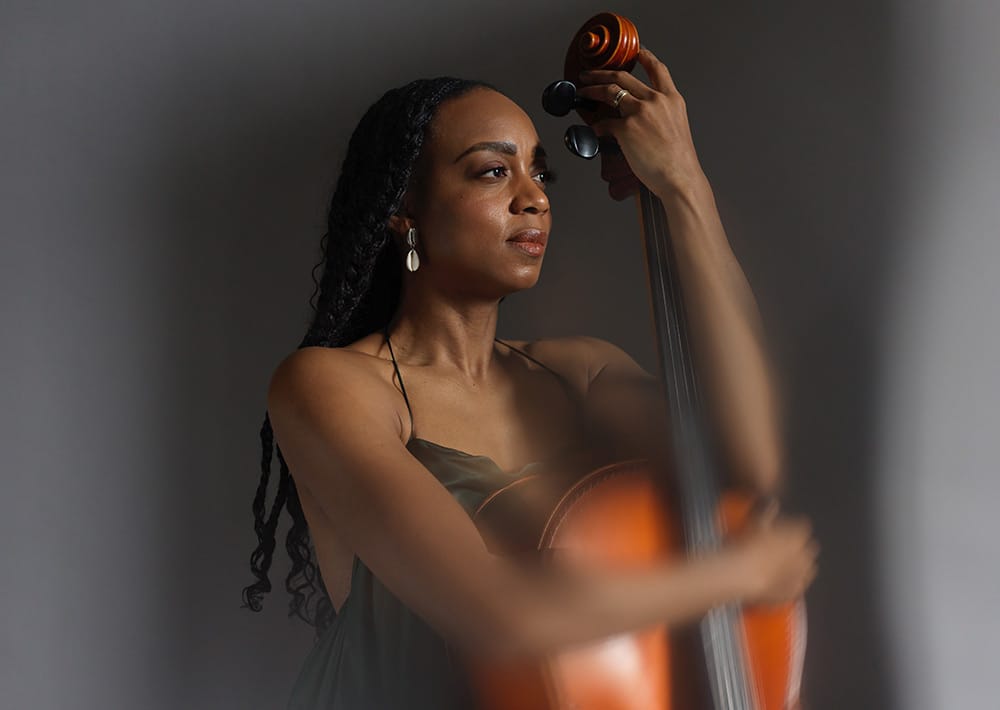
Ayanna Witter-Johnson: “I tend to write economically, stripping lyrics back until only the essential lines remain.” Photo: Jordan Woods
The composer and songwriter discusses finding emotional truth through restraint, and allowing harmony, resonance, and silence to become storytelling partners
MOBO Award-nominated singer-songwriter, cellist, composer, and pianist Ayanna Witter-Johnson makes music that’s difficult to pin down, bringing together soul, jazz, classical, reggae, and R&B in a way that feels entirely her own. Whether performing solo, collaborating with artists including Peter Gabriel, Andrea Bocelli, and Anoushka Shankar, or composing for leading orchestras, she moves comfortably between musical worlds.
Her second album, New Roots, arrives on 18 September, exploring identity, heritage, spirituality, and self-discovery through songs written over several years. Its final preview, Blue, is one of the record’s most understated moments, using voice and cello to explore pain, healing, and the stories we tell ourselves, as Ayanna explains below…
“Don’t be afraid to let the instrument do some of the storytelling for you”
INSPIRATION
Blue began life before the pandemic during a week-long writing retreat while I was house-sitting in Tufnell Park in London. I’d set myself the challenge of writing an album in a week! Not with the expectation that every song would make the final record, but more as a practice and because I wanted to silence my inner critic and simply create. Just be in flow. Some songs arrived fully formed, which was a miracle, and others became sketches. Blue was one of the fully formed songs that stayed with me.
At the time, I was processing the emotional aftermath of a toxic work relationship, where I found myself replaying conversations, questioning decisions, and carrying a deep hurt long after the working relationship had ended. Writing about it became my way of alchemising those feelings rather than simply suffering at the hands of them.
What’s been interesting is how the meaning of the song has evolved over time. Years later, I no longer hear Blue as being about one person. Instead, it feels like a meditation on the patterns we can all fall into, where we become so familiar with pain that it almost becomes part of our identity. Telling ourselves stories about who we are and why things happen to us, and those stories can be surprisingly difficult to let go of.
For me, Blue has become less about hurt and disappointment and more about asking myself a difficult question: What part am I playing in my own suffering?


‘Elizabeth Preston’ by Elizabeth Preston (EP)
On this loopy cellist’s debut, each song starts with a grain of an id... Read More+Song Deconstructed: ‘Anything But Easy’ by Lisa Redford
The award-winning singer-songwriter, music columnist and tutor returns with... Read More+Melody is king
Nashville-based songwriting coach Mark Cawley looks at the core music-makin... Read More+





Ayanna Witter-Johnson: “Only later do I return to shape the lyric properly, once I know what the harmony is asking of it.” Photo: Hypemari
LYRICS
I rarely begin with a fully formed concept. More often than not, a single lyric will arrive almost hand in hand with a melody. They’re usually inseparable. Once that first idea appears, I’ll sit at the piano and improvise around it, singing complete nonsense for a while as I search for the emotional world of the song. Only later do I return to shape the lyric properly, once I know what the harmony is asking of it. That’s exactly how Blue came into being.
By the time I started refining the words, I’d already discovered the emotional landscape through the music, and the chorus became the anchor:
“Why do I choose to paint myself blue over you?”
A magazine to keep. An archive to explore.
Get the latest edition, 40+ back issues, 3,200+ website articles and expert insights for songwriters
I was drawn to the concept of painting because it suggests agency. Blue is a colour often associated with sadness, but painting myself blue implies participation rather than simply circumstance. The lyric quietly shifted the question away from’What happened to me?’ towards ‘Why am I continuing to carry this?’
I tend to write economically, stripping lyrics back until only the essential lines remain. I’d much rather create space for the listener than explain every detail. The verses hint at emotional states rather than narrating events:
“There’s a picture I’m dreaming / And a feeling I’m seeking…”
or
“No substitutes for learning how to listen to my inner voice.”
Those lines intentionally leave room for interpretation. They’re not trying to tell one story; they’re inviting listeners to recognise their own. One thing I’ve learnt over the years is that songs rarely need to provide answers. Often asking the right question is enough.

MUSIC
Although I often end up writing on the cello, Blue actually began at the piano. Once I’d found the lyric, melody, and harmonic movement, I migrated over to the cello, where the song really found its home.
It happens to sit beautifully on the instrument. The lowest note of the accompaniment is an open C string, and I make a lot of use of the cello’s open-string tuning throughout the song. Unlike the piano, the cello doesn’t have a sustain pedal, so when I’m arpeggiating chords I’m always thinking about how to let certain notes continue ringing while I move to the next harmony.
Those open strings create their own resonance. They allow the harmony to bloom without me having to constantly restate every chord, so fewer notes actually communicate more. I love that kind of economy. It creates a bed that supports the vocal rather than competing with it.
I never think of the cello as simply accompanying the voice. For me, it’s another storyteller. Sometimes it’s carrying the emotional subtext, saying the things the lyric can’t quite articulate. In Blue, the resonance of the open strings creates a feeling of spaciousness and acceptance, almost as though the instrument is holding the emotions the vocal is trying to make sense of.
As both a singer-songwriter and cellist, I’m always thinking about space. Silence is part of the arrangement. Resonance is part of the arrangement. Sometimes allowing one note to keep ringing is far more expressive than adding five new ones. That’s probably one of the biggest lessons I’ve learnt as a songwriter: don’t be afraid to let the instrument do some of the storytelling for you.
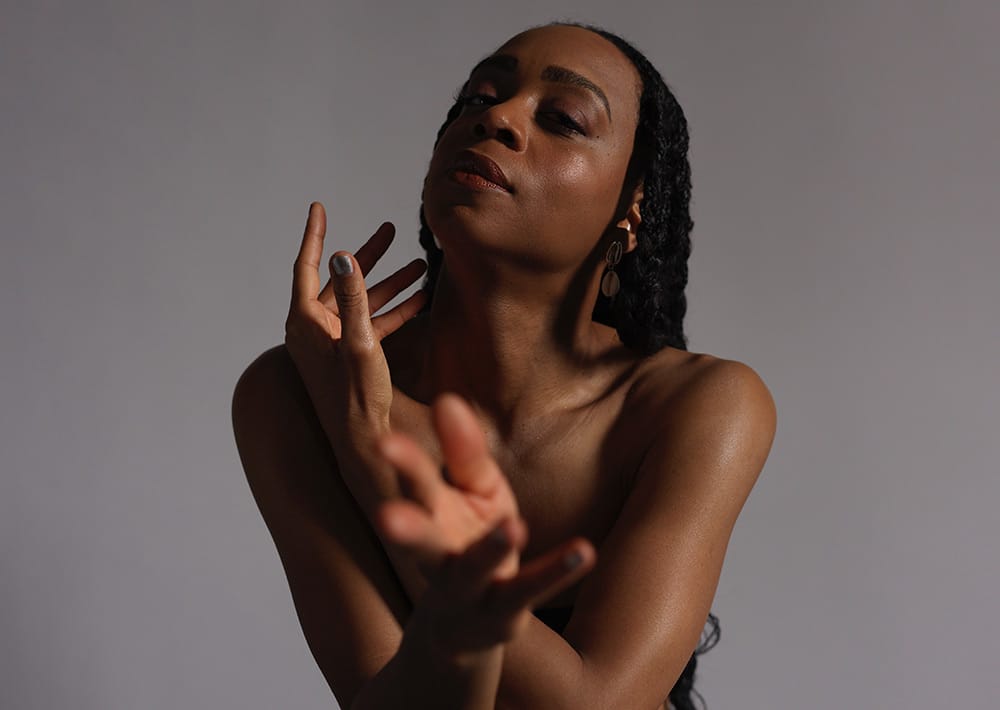
Ayanna Witter-Johnson: “One thing I’ve learnt over the years is that songs rarely need to provide answers. Often asking the right question is enough.” Photo: Jordan Woods
IN THE STUDIO
Producing Blue became an exercise in trust for me. My instinct and past experience would tell me to keep adding layers. Another harmony. Another instrument. Another texture. But every time I reached for something else, the song quietly reminded me it didn’t need any more. In the end, less really was more.
I recorded both the vocal and cello parts myself before sending the stems to my keyboard player at the time, who added some beautifully understated Prophet synthesiser textures. Those synths aren’t there to dominate the track; they simply introduce a subtle cosmic quality, almost like another atmosphere sitting behind the acoustic performance.
The restraint in the arrangement mirrors the message of the song itself. Blue asks what happens when we stop clinging to pain. The production posed a similar question: what happens if we stop adding? Every time I reached for another instrument, the song quietly reminded me it already had everything it needed.
I’ve found that’s often true in songwriting. If the emotional core is strong enough, you don’t need to decorate it. Sometimes the bravest production choice is knowing when to stop.
FINAL THOUGHTS
Blue has taught me that songs continue to reveal themselves long after you’ve written them. What began as a way of processing one difficult relationship has gradually become something much broader. Every time I perform it, I hear it through a slightly different lens.
Looking back, I realise Blue wasn’t teaching me how to recover from one relationship. It was teaching me how to trust myself again. In many ways, it quietly planted the seeds for the whole of New Roots, my sophomore LP, which it’s featured on.
Blue isn’t about sadness. It’s about awareness. The moment I noticed the stories I’d been telling myself was the moment I realised that change was possible, and the beauty of being a songwriter is to create an honest space where questions can exist and be explored. If the song offers anything, I hope it’s permission to ask ourselves difficult questions with kindness, because that’s where growth begins.
Blue by Ayanna Witter-Johnson is out now, with the album New Roots to follow on 18 September. Find out more via ayannamusic.com
More Like This
Barry Blue’s tips on surviving for 50 years as a songwriter
The legendary British songwriter and producer offers some wise words for an... Read More+‘Elizabeth Preston’ by Elizabeth Preston (EP)
On this loopy cellist’s debut, each song starts with a grain of an id... Read More+Song Deconstructed: ‘Anything But Easy’ by Lisa Redford
The award-winning singer-songwriter, music columnist and tutor returns with... Read More+Melody is king
Nashville-based songwriting coach Mark Cawley looks at the core music-makin... Read More+








More Like This