
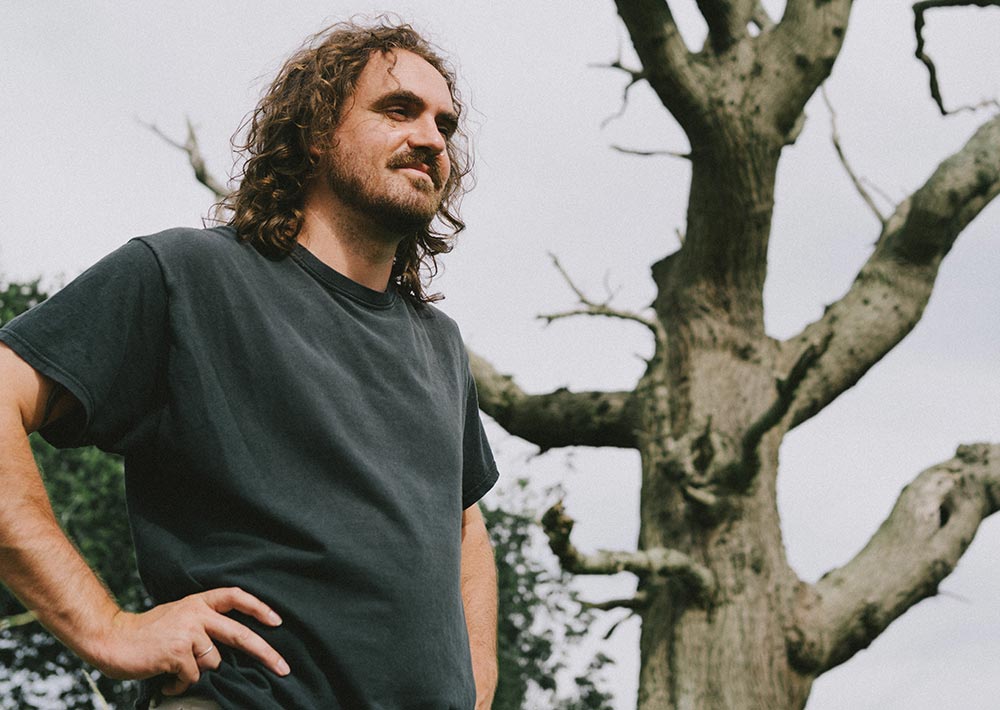
Blair Dunlop: “If it means something to you, there’ll always be a way to make it interesting and meaningful.” Photo: Ania Shrimpton
A new album gives us a chance to take a deep dive into the lyrical world of this eminent troubadour
Watching Blair Dunlop’s career unfold has been a lesson in the possibilities of inheritance: how a musician might honour his roots without becoming confined by them. The British troubadour has travelled some distance from his traditional folk beginnings, making room for a broader sonic palette, and adding a sly levity to the existential questions that have always animated his writing.
On What Still Survives, his sixth album, Dunlop’s lyrical powers are operating at full tilt. Fossils become meditations on mortality (Trilobite); the itinerant songwriter’s life is distilled into the meta Pasadena; technological alienation and heartbreak acquire an intimate, human scale on Are You Loved and Pax Romana. Together, these songs form a quietly searching study of endurance, the restorative power of nature, and ultimately, of what we carry and what we lose.
A longstanding friend of the magazine, Dunlop joined us during a day off from supporting Shawn Colvin. Here, he discusses the craft behind the news songs, with a particular focus on how he finds the right words…
Find out about the Bristol Song Circle, hosted by Blair Dunlop
How deliberate are you initially with your lyrics? How does that nascent stage tend to happen?
“I think this is a result of me being around traditional ballads from quite a young age, but I’ve always had songs where I’ve deliberately written about certain things that are linear and tangible, and I guess “balladic” in the original sense, about specific things, and I’m very deliberate about those. Often, they’re the songs that might take a little bit longer to write.
“But then, I have other songs that are not as influenced by folk heritage. They are more emotive and I am less deliberate about the lyrics. So, there’s a scope. But there’s not one way or the other way, there’s almost a spectrum, but I do it both ways really, and I think it’s important for me to do both of those things because, if I write too many songs that are airy-fairy, I get bored and I want to write about something tangible with specific themes that I can get into.
“Likewise, if I write too many that are very descriptive and precise about either historical things or that are more of the folk ballad/linear storytelling thing, then I get really bored of that and want to write something that’s a bit more esoteric. I recognise that some people have a set way of doing it, but for me, I’ve always enjoyed doing both.”
A magazine to keep. An archive to explore.
Get the latest edition, 40+ back issues, 3,200+ website articles and expert insights for songwriters
And when it’s those more deliberate themes, will you think of or see something that inspires you and then go and research it?
“Yes, it’s exactly that. It’s always, I see a 1989 Lancia Delta Integrale and I want to write about that [1989 San Remo Conqueror]. Or I want to write about this famous fossil that I found… on this album, I have a song called Trilobite. It’s quite an irreverent song. I was chatting to my host last night, actually, after I played in Glasgow, and they mentioned Loudon Wainwright, and I thought, ‘Oh, that’s an interesting reference point,’ because I’ve grown to love that playfulness.
“Growing up, I loved Rufus Wainwright. I loved Rufus’s voice, and I didn’t really get the Loudon thing. One of my teachers lent me a Loudon record, and it was cool, but I wasn’t ready for it. Then, as I got older, I learned to really love him.
“But if I bring it back to the example of Trilobite, that song is of that mould. It’s abstract and it’s quite silly, but it touches on some biological and geological truths. I went away and researched, came back, and shoehorned them into a song in a playful way. That occupies a completely different part of my brain than writing a song about a breakup, yearning, or grief… something that’s broader and more relatable to people.”
Tell us about that other way?
“When I’m writing a heartfelt song, I’m not going away on Wikipedia or googling, ‘What happens in heartbreak?’ I’m tapping into my own well of emotions and getting into a nostalgic and vulnerable headspace. Whereas, when I’m doing the songs that are about specific things, it’s the logical part of my brain and often a comedic part of my brain, not always but certainly on a song like Trilobite.
“Then, that literally goes into another song called Dalmatia, Hiding, which is very abstract. It’s to do with someone who’s not in my life anymore, and it’s about yearning and memories. I know what it’s about, but it’s definitely open to interpretation, and I love that, but it’s a completely different vibe to Trilobite.
“I’d like to think they both sit on the same album, sonically, and it’s not too incongruous. But, in terms of my process of writing, it’s a completely different side of my brain, and doing the more emotive songs – they often flow out and write themselves. Whereas, when I’m trying to hit specifics about more niche subject matters, I have to take the time to go away and pick through the bones of the subject, do a bit of research, come back, and then shoehorn some stuff in. It can take a bit longer, but it’s an enjoyable process. But I do find, broadly speaking, the more relatable/common themes/emotive songs, they tend to be a quicker process.”

Meet The Songwriters: Bristol Song Circle
Blair Dunlop, Luke Sital-Singh, Kitty Macfarlane, and Eva Parfitt each refl... Read More+Song Deconstructed: ‘From The Blue’ by Painted Sky
George Brandon on how he put together this classic folk ballad about a doom... Read More+Interview: Amy Rigby
The iconic mod housewife is back with an album that finds her songwriting a... Read More+


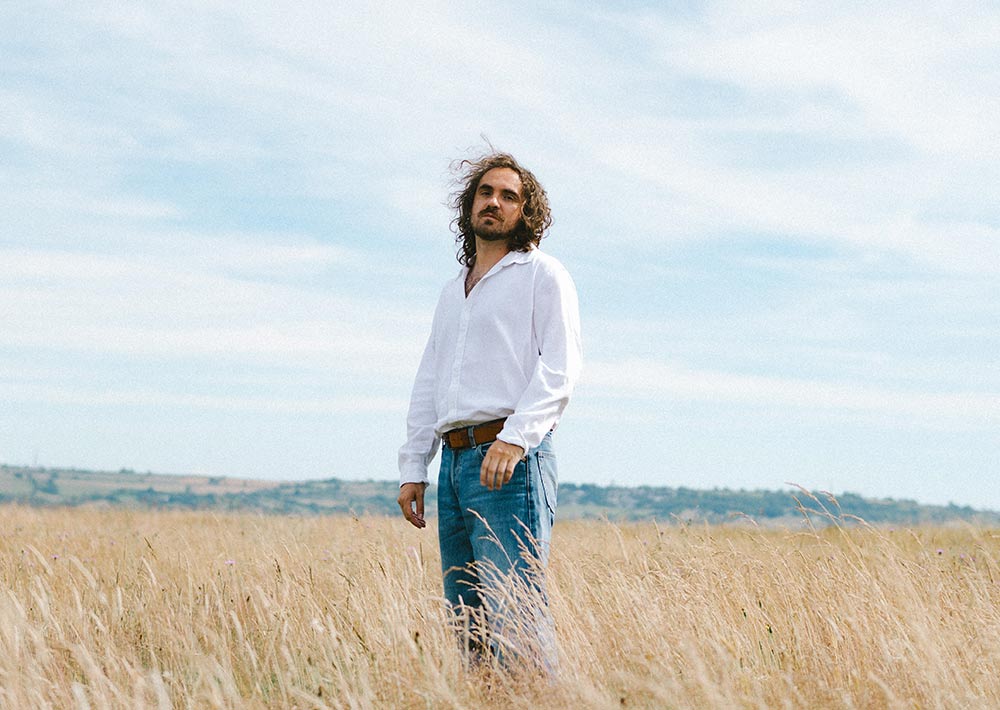
Blair Dunlop: “The darkness in my personal life brought out a lightness in my songs.” Photo: Ania Shrimpton
Trilobite starts off as this very specific thing, but then you turn it into a tale of endurance, one that gave you the title of the album. With those songs, you’re taking something very specific and broadening it to give it an emotional anchor, but on other songs you do the reverse – they start with those broad themes of love, heartbreak, friendship, struggling to get through the day, but you then find ways to make them personal. It’s almost like they mirror each other. One starts broad and becomes specific, and one starts specific and becomes universal…
“That’s really interesting. I’ve actually never thought about that, but I think I agree. Actually, if I think about some of the lyrics now, maybe in terms of taking a trilobite and making it relatable, that is maybe more of a conscious thing because I’m like, ‘How can I turn this into a song? How can I make it work and make myself comfortable delivering it?’ and really, in that song in particular, it’s really about finding a snappy chorus that pulls it all together, and I guess, like you say, it broadens it out.
“I must have been aware of that as I was writing it. But in terms of the reverse of that, and honing in on really specific lines of an emotive song… Okay, so I have a new song called Looking Through, and it’s quite a visceral description of the trees, what they’re saying to me, and how my perception of the trees changes with the mood that I’m in. I paint quite a vivid picture of that, even though the whole thing is about existential anxiety. That’s not something that was ever a conscious thing.
“Maybe it’s the folk upbringing within me where I need to link this to something tangible so that people can grasp it. Maybe it’s a default mechanism within me that I need to get enough specific imagery or it’s not a valid song. I don’t think that’s right or wrong, but maybe that’s an explanation for it. Even in my most heartfelt songs, I do like to be able to hang it on something tangible.”
There seem to be a few meta references to your life as a songwriter and musician, on songs like Pasadena, for example. Is that fair?
“Yeah, Pasadena, big time. It’s not something I’d ever done, really. Pasadena just came out of… I was listening to some West Coast stuff, and I saw a reel on Instagram of this guy, Medium Build, and he was so real and honest. I’ve not really written anything so viscerally about my situation, almost tongue-in-cheek, speaking about the fact that I’m a musician.
“I didn’t know if I was gonna scrap it, but in the end, I really enjoyed writing it and it came out pretty quickly. It goes down well live, so I’m happy. I do sometimes wonder if it sits aside from the rest of my body of work, but I like it. It said what I wanted to say at the time. I was just pondering my life as a musician, and I wanted to get it out. I didn’t think, ‘Oh, this would be a good thing to write about because X and Y.’ I certainly don’t think I am a particularly interesting subject matter.
“It definitely wasn’t one of those things where I was like, ‘Oh, I really want to write about a fossil from the Cambrian explosion.’ Like, ‘I really want to write about this singer-songwriter from Chesterfield.’ But it definitely came from an emotive place where I was inspired by the raw energy of Medium Build. I liked his energy, and it hit me in the feels, as music so often does. I’m very grateful to say that it still does after doing this for 15/20 years. It was an emotional response where I might as well have been writing a song about an ex-partner, my parents ageing, or whatever it was. It came from an emotive place where I wanted to express, in an entertaining way, my life as a musician: professional struggles, self-doubt, and where I am in my life.”
Where did that sit in terms of your process?
“It was definitely on that more emotive side of things. And maybe that’s the best example of what you discussed, in terms of taking something overarching, like where I’m at in my life, but then it being a load of specific references that are almost puns, and chaining them together. I’ll never set out for it to be like that. It just came out like that, and then you run with it. When a song’s going in a certain direction, you can go, ‘Are you feeling yourself, or are you not feeling yourself?’
“If you’re not feeling yourself, you go, ‘I’ll pare that back and I’ll play it safe and I’ll maybe bring it towards this direction.’ Or you go, ‘This is going to be 100% X or 100% Y.’ That song is 100% silly, self-deprecating, and that’s where I went with it. It’s not something I’d ever done before; it just came out really quickly. Now, having written that, I’m like, ‘Well, I don’t need to write another song about that. I’ve done that.’”
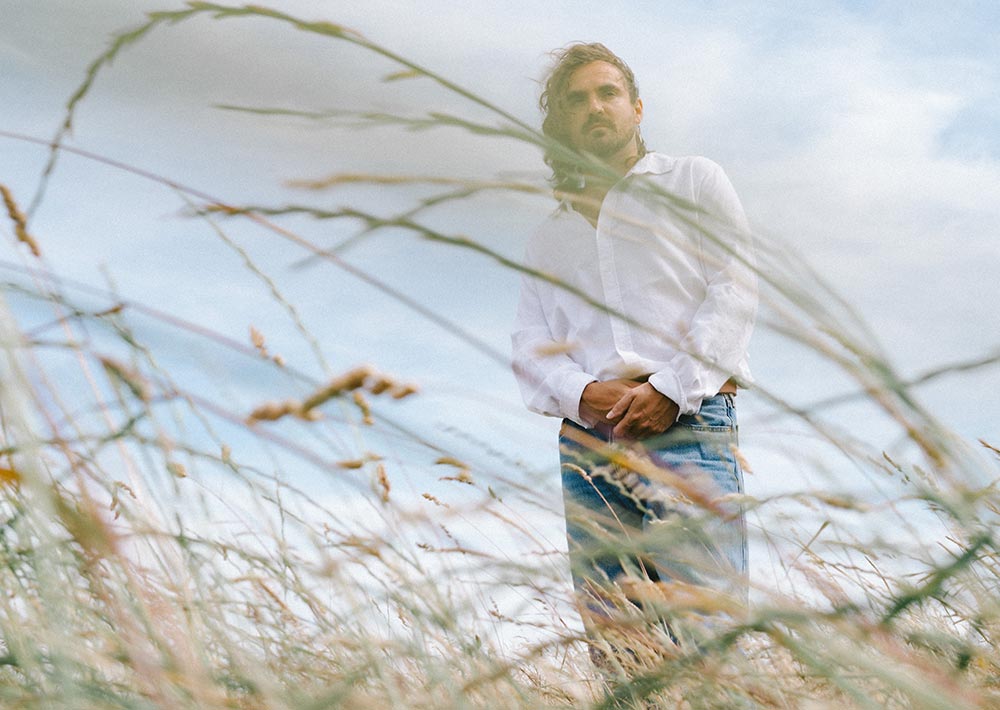
Blair Dunlop: “I never knew how freeing it would be to actually let my personality come to the fore.” Photo: Ania Shrimpton
You’ve mentioned humour a couple of times. Is adding that to songs something that comes naturally and how do you avoid it becoming a “comedy” song?
“I don’t think about that. When I first started, I took myself very seriously as a songwriter, and it was never a conscious thing. I was a product of my musical upbringing, and I was almost writing in the image of my peers, and family, and the scene. I never knew how stifled I felt by the image of the tortured poet that I was subconsciously projecting. I never knew how freeing it would be to actually let my personality come to the fore. It took the best part of a decade to get that out there.
“I got to a point where I was like, ‘There’s some kind of dissonance going on here,’ because, actually, I’m a pretty light-hearted guy. I like humour in life. Of course, I like to think deeply about things, and that’s why I write, because I want to get my emotions out. I wanted to write about heavy things, or explore poetic themes that didn’t fit into the humorous side of my personality. But after a few years, I was just like, ‘This is not really who I am.’
“I can inhabit it for a bit, but I’m not going to do four albums trying to be Keats. I’d rather just be me, and that’s the point where I’m at now. I’m not saying it’s where I’m going to be forever, but the last couple albums have had some humorous lines in. I’m not trying to be Jake Thackray, I’m just trying to be me, and it’s coming out like it is.”
Were there songs that unlocked that for you?
“One of the first times ever, and it’s not a humorous song, but it is playful, and that’s a song that I wrote about a Porsche 356 on my third album [356 on Gilded]. I was like, ‘Oh, that’s cool.’ Around that time, I had a really bad time in my personal life. That album was doing quite well. I’d had some Radio Two playlists. I played Glastonbury. I was touring abroad quite a lot, and things were looking good. But I was also having an awful time in my personal life. It took hitting rock bottom around 10 years ago for music to become more of a sanctuary than a job.
“I always loved music, but I didn’t realise how lucky I was to be doing it full time until I was having such a bad time away from the stage that, when I went back to the stage, it was like, ‘Oh my god, I can get lost in this.’ Then it started to reframe how I saw my professional obligations – see them less as a means to an end, and more as a great privilege to be able to do what I do for a living.
“Around about that same time, that would have been coming into my fourth album, I saw a massive spike in my ability to hold the stage. I think that was as a direct response to caring less, in a good way. I was like, ‘Why would I care about how I’m coming across here, and why would I care about fitting into this box of what people in the English folk circuit think of me, or what my parents think of me, or what my friends think of me. I’m just gonna do me.’”
That must have been a pivotal moment for you…
“The darkness in my personal life brought out a lightness in my songs. Around that time, I felt so much better at portraying myself on stage, because I just gave less of a shit. That’s when I started writing a broader scope of things, including some light-hearted stuff about myself. It’s intrinsically tied to me playing live; as I started to show my personality on stage, chatting between songs, that then started to reflect itself in my songwriting.
“I’ve always played so much, and that’s a privilege to be able to do that, but I’m also informed by that because that’s my forum for sharing my music. So, if I felt like I was being truly myself on stage between the songs, then over time that naturally extended into the songs themselves. As the overall vibe of my gigs became light-hearted, I was nestling into my true self, coming out of the cocoon of the darkness of my personal struggles. That very much showed itself in the songs. It was almost like the inverse of, you have a crap time and then you write about it and you write a really depressing album about how you’ve been depressed. It’s worked the other way for me, and I’m still riding that, to be honest.
“Even 10 years on from that, it still feels like a newfound exuberance and joy for playing live. Some people might be like, ‘I prefer his earlier stuff when he was writing more miserable songs,’ but I don’t care. The songs I’m writing now are some of the best I’ve ever written, and certainly the most enjoyable.”
It’s great that you don’t do that songwriter thing of sabotaging your own happiness in order to have experiences to mine for your material…
“No, I cannot express how much more I would have to care about my career to do that. I’m not willing to do that. I’ve been in some dark places, and I’d rather do what I can to avoid that. I find joy in playing now, but you can have that cathartic exploring of the pain and writing something that is ostensibly depressing or melancholic. But there’s great beauty and joy in that. I think the vast majority of musicians who write depressing things would also agree that that’s a joyful experience. You’re wallowing in the mire, but it’s a cathartic experience.
“I still love that, but I probably do it less because I’m in a stable relationship with nice people around me, but the day I lose that completely will be a very sad day, because there’s always going to be sadness, and that’s one of the best things about doing what we do. It’s not even about doing it professionally; it’s about the process of translating the sadness into something that makes you understand yourself better, and understand the world better, and heals you in some way.”
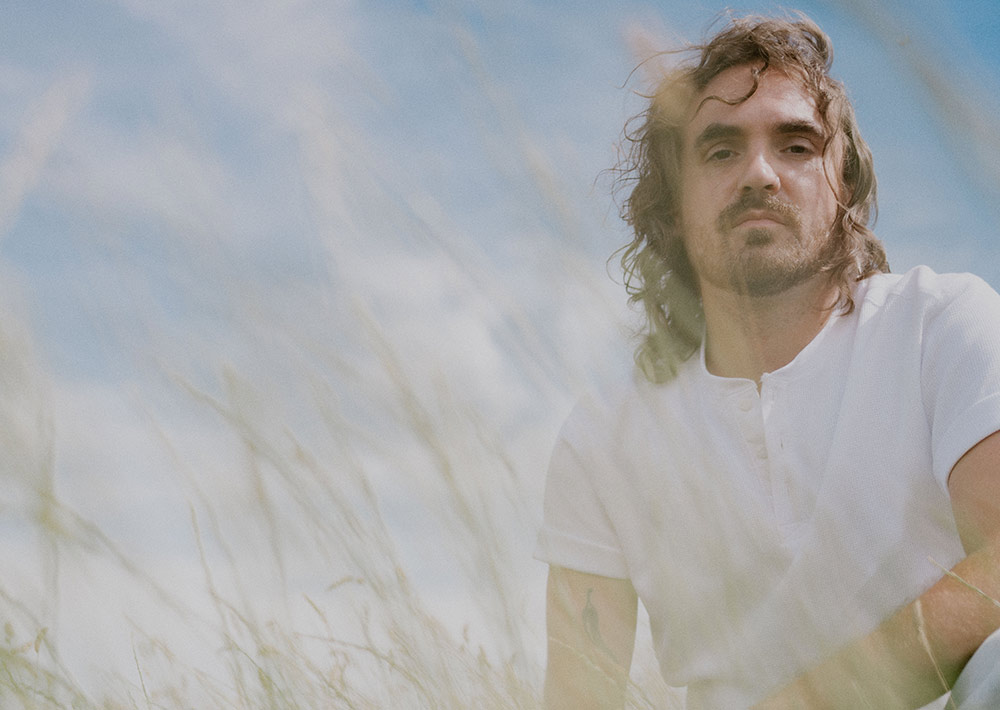
Blair Dunlop: “Even in my most heartfelt songs, I do like to be able to hang it on something tangible.” Photo: Ania Shrimpton
Another thing we want to talk about is the fact that you often reference countries, cities, and other places in your songs. Why do you think that is?
“That’s really interesting. This has never been a conscious thing. I’m lucky to travel. I’ve always been interested in different cultures, and I’m very fortunate and I can travel with work and aside from work. With work, that’s one of the really beautiful things about what we do for a living. That I get to travel is never ever lost on me, and I enjoy it more and more as I get older, but I think it comes back to that subconscious tangibility thing; I can hang it on something specific from a culture or from a land. That gives a vivid framework to hang my esoteric ideas on. It’s never something that I’ve ever consciously thought about.”
What advice could you give someone who wants to incorporate elements of the landscape or specific places into their own writing?
“It always comes back to what inspires you. So, what inspires you about that place? Have you been to a place that you love? Is there something visceral about a time in your life that you spent in a particular place? Are you inspired by nature, culture, social things? When you travel, what do you like? Are you going to watch a football match in Istanbul? Okay, well, write about the Galatasaray or Fenerbahçe fans.
“It can be as it can be as specific or as broad as you want because, ultimately, it’s just a different lens to talk about the same stuff that we see every day. You want to talk about nature? You can talk about the cypresses in the Mediterranean if that helps you tell your story. You can talk about the food from a region, social norms, history… It could be anything about any land or any place. It’s just about what connects you to it, what excites you.
“That’s what I keep coming back to now. What do I want to write about? Ultimately, my main thing would be, in terms of the process of songwriting and enjoying it, don’t be scared to write about the most random thing. If it means something to you, there’ll always be a way to make it interesting and meaningful.”
Is that something you like in the music you listen to?
“I love it when people are happy to write about stupid things that other people don’t want to write about because it means something to them. That’s character, and that’s what we’re losing in this homogeneous world. That’s the beauty of being able to write songs yourself. I don’t have to write about Of Mice And Men because I’m in this class and I have to do an exam.
“You can write about literally anything. I’m currently looking at a toaster. I bet someone’s written a great song about a toaster. It’s not going to be a No 1 hit, but you can talk about how it was constructed, who invented it, what you use it for… How does it make your life better? Did it inspire a conversation? You can take anything and explore an entire world within the minutiae of that specific thing. There’s always a way to relate. If you’ve got a really niche interest and you think no one’s going to want to hear about that… I want to hear about that, and I bet someone else wants to hear about it too.
“That goes for the geographical elements as well. You can talk about the soil in a certain place, and I bet there’s a beautiful metaphor within that about how we grow as a society. There are no rules for this, and the more outlandish and niche you are, the better, because that’s going to be more unique as well.”
Bringing it back to the album to finish with, are you happy with how successfully you communicated the messages you wanted to convey?
“On this album… It was never meant to be a concept album. It’s not a concept album. It has themes, but it was never meant to be about steadfastness, endurance, nature, and all the things that it’s kind of come to be about. I never meant it to be that; I was just writing the songs I wanted to write at this time in my life.
“Maybe a better way to put it is that I didn’t set out for it to be anything other than an expression of a time. What I do think is that it’s conveyed where I am in my life, and I think it sounds good because the producer [Ian Grimble] and the people who played on it have done a great job. I think it sits fairly cohesively together in that way.
“I never set out to do anything with the album other than express where I’m at. Retrospectively, it’s turned into a vision, in the sense that there are certain themes that recur, and I think it sits as a cohesive body of work better than some of my previous stuff, and that’s my framework. In that regard, I’m very happy with it.”
Blair Dunlop’s new album What Still Survives is out now on Navigator Records. Blair will also be touring the UK in November. Find out more at blairdunlop.com
More Like This
Interview: Blair Dunlop
Returning to an unrecognisable scene with his first studio album in half a ... Read More+Meet The Songwriters: Bristol Song Circle
Blair Dunlop, Luke Sital-Singh, Kitty Macfarlane, and Eva Parfitt each refl... Read More+Song Deconstructed: ‘From The Blue’ by Painted Sky
George Brandon on how he put together this classic folk ballad about a doom... Read More+Interview: Amy Rigby
The iconic mod housewife is back with an album that finds her songwriting a... Read More+






More Like This