

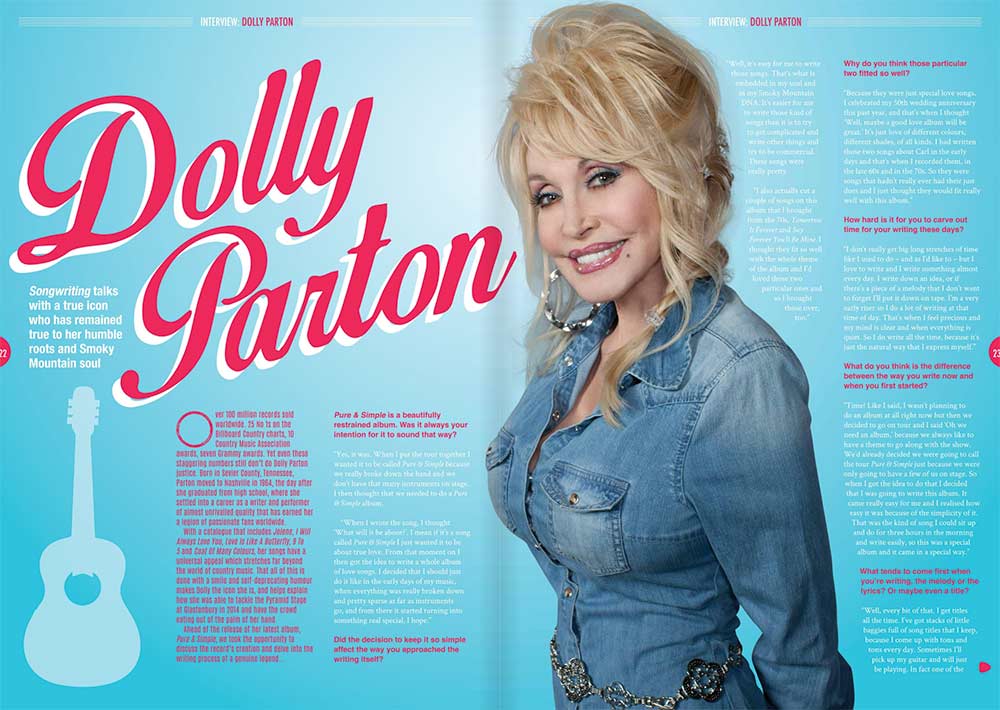
Dolly Parton: “When you’re a songwriter it’s like being an actor playing a role. I have to become whatever it is that I’m writing about.”
We were lucky to speak with a true icon who remained true to her humble roots and Smoky Mountain soul
Editor’s Note: Originally published in Songwriting Magazine Autumn 2016 – republished in August 2026 following the sad news of Dolly Parton’s passing
Over 100 million records sold worldwide, 25 No 1s on the Billboard Country charts, 10 Country Music Association awards, seven Grammy awards. Yet even these staggering numbers still don’t do Dolly Parton justice. Born in Sevier County, Tennessee, Parton moved to Nashville in 1964, the day after she graduated from high school, where she settled into a career as a writer and performer of almost unparalleled quality that has earned her a legion of passionate and diverse fans worldwide.
With a catalogue that includes Jolene, I Will Always Love You, 9 To 5 and Coat of Many Colours, her songs have a universal appeal which stretches far beyond the world of country music. That all of this is done with a smile and self-deprecating humour makes Dolly the icon she is, and helps explain how she was able to tackle the main stage at Glastonbury in 2014 and have the crowd eating out of the palm of her hand.
Ahead of the release of her 2016 album, Pure & Simple, we took the opportunity to discuss the record’s creation and delve into the writing process of a genuine legend.
First published in Songwriting Magazine Autumn 2016
Pure & Simple is a beautifully restrained album. Was it always your intention for it to sound that way?
“Yes, it was. When I put the tour together, I wanted it to be called Pure & Simple because we really broke down the band and we don’t have that many instruments on stage. I then thought that we needed to do a Pure & Simple album.
“When I wrote the song, I thought, ‘What will it be about?’. I mean, if it’s a song called Pure & Simple, I just wanted it to be about true love. From that moment on, I then got the idea to write a whole album of love songs. I decided that I should just do it like in the early days of my music, when everything was really broken down and pretty sparse as far as instruments go, and from there it started turning into something real special, I hope.”
Did the decision to keep it so simple affect the way you approached the writing itself?
A magazine to keep. An archive to explore.
Get the latest edition, 40+ back issues, 3,200+ website articles and expert insights for songwriters
“Well, it’s easy for me to write those songs. That is really what is embedded in my soul and in my Smoky Mountain DNA. It’s easier for me to write those kind of songs than it is to try to get complicated and write other things and try to be commercial. These songs were really pretty.
“I also actually cut a couple of songs on this album that I brought from the 70s, Tomorrow Is Forever and Say Forever You’ll Be Mine. I thought they fit so well with the whole theme of the album and I’d loved those two particular ones and so I brought those over too.”
Why do you think those particular two fitted so well?
“Because they were just special love songs. You may or may not know that I celebrated my 50th wedding anniversary this past year, and that’s when I thought, ‘Well, maybe a good love album will be great.’ It’s just love of different colours, different shades, of all kinds. I had written those two songs about Carl [Dean] in the early days and that’s when I recorded them, in the late 60s and in the 70s. So they were songs that hadn’t really ever had their just dues and I just thought they would fit really well with this album.”

How hard is it for you to carve out time for your writing these days?
“I don’t really get big long stretches of time, like I used to do and like I’d like to do, but I love to write and I write something almost every day. I write down an idea and if there’s a piece of a melody that I don’t want to forget I’ll put it down on tape. I’m a very early riser so I do a lot of writing at that time of day. That’s when I feel precious and my mind is clear and when everything is quiet. So I do write all the time, because it’s just the natural way that I express myself.”
What do you think is the difference between the way you write now and when you first started?
“Time! Like I said, I wasn’t planning to do an album at all right now but then we decided to go on tour and I said, ‘Oh, we need an album,’ because we always like to have a theme to go along with the show. We’d already decided we were going to call the tour Pure & Simple just because we were only go to have a few of us on stage. So when I got the idea to do that I then decided that I was going to write this album. It came really easy for me and I realised how easy it was because of the simplicity of it. That was the kind of song I could sit up and do for three hours in the morning and write easily, so this was really a special album and it came in a special way.”
What tends to come first when you’re writing, the melody or the lyrics? Or maybe even a title?
“Well, every bit of that. I get titles all the time. I’ve got stacks of little baggies full of song titles that I keep because I come up with tons and tons every day. Sometimes I’ll pick up my guitar and will just be playing. In fact, one of the songs on the album, Never Not Love You, came that way. I had got a new 12-string guitar and I was loving the sound of it. It was just ringing after I’d played a little lick on it, and all of a sudden that song just came to be. I was trying out the sound and all of a sudden there came the melody and then I just started saying the words. So it’s something that happens at different times in different ways.”

Interview: Sarah Darling
On the eve of her latest album release, we catch up with a country singer-s... Read More+Melody is king
Nashville-based songwriting coach Mark Cawley looks at the core music-makin... Read More+5 Minutes With… Izzy Bizu
We learn all about new single Walk Away, streaming sensation White Tiger, a... Read More+




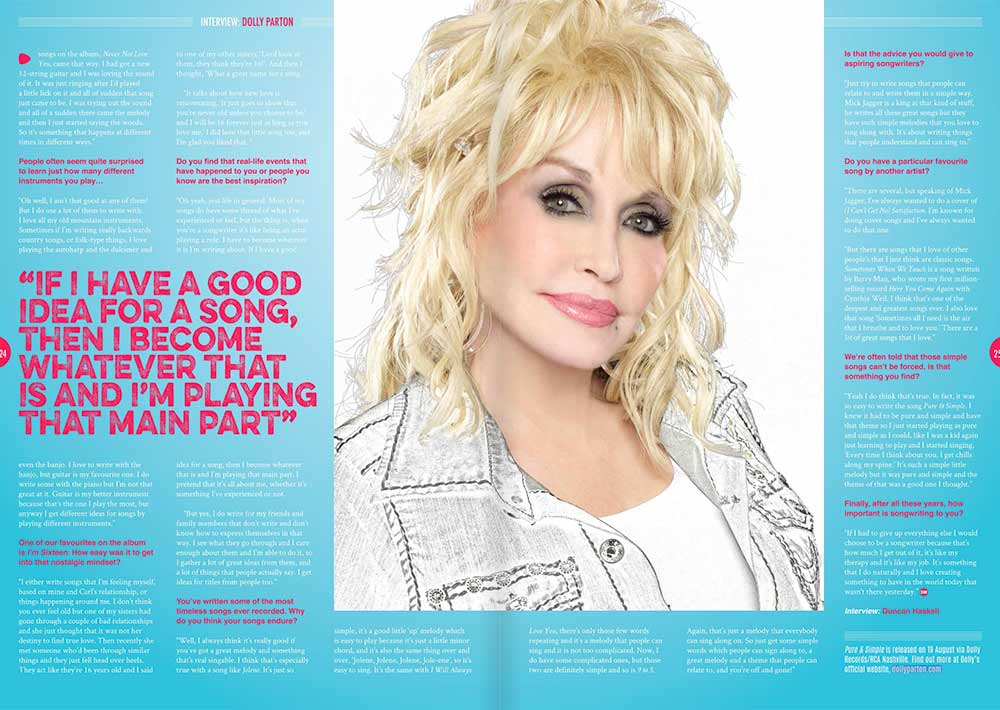
Dolly Parton in Songwriting Magazine Autumn 2016
People often seem quite surprised to learn just how many different instruments you play…
“Oh well, I ain’t that good at any of them, but I do use a lot of them to write with. I love all my old mountain instruments. Sometimes if I’m writing really backwards country songs, or folk- type things, I love playing the autoharp and the dulcimer and even the banjo. I love to write with the banjo but guitar is my favourite one. I do write some with the piano but I’m not that great at it. Guitar is my better instrument because that’s the one I play the most, but anyway I get different ideas for songs by playing different instruments.”
One of our favourites on the album is I’m Sixteen – how easy was it to get into that nostalgic mindset?
“I either write songs that I’m feeling myself, based on mine and Carl’s relationship, or things happening around me. I don’t think you ever feel old but one of my sisters had gone through a couple of bad relationships and she just thought that it was not her destiny to find true love. Then recently she did find true love with someone who had been through similar things and they just fell head over heels. They act like they’re 16 years old and I said to one of my other sisters, ‘Lord, look at them, they think they’re 16!’. And then I thought, ‘What a great name for a song…’
“It talks about how new love is rejuvenating, ‘It just goes to show that you’re never old unless you choose to be/and I will be 16 forever just as long as you love me.’ I did love that little song too, and I’m glad you liked that. “
Do you always find that real-life events that have happened to you or people you know are the best inspiration?
“Oh yeah, just life in general. Most of my songs do have some thread of what I’ve experienced or feel, but the thing is, when you’re a songwriter it’s like being an actor playing a role. I have to become whatever it is that I’m writing about. If I have a good idea for a song, where I think, ‘Wouldn’t that make a great song’, then I become whatever that is and I’m playing that main part. I pretend that it’s all about me, whether it’s something I’ve experienced or not.
“But yes, I do write for my friends and other family members that don’t write and don’t know how to express themselves in that way. I see what they go through and I care enough about them and I’m able to do it, so I gather a lot of great ideas from them and a lot of great things that people actually say and I get ideas for titles from people too.”
You’ve written some of the most timeless songs ever recorded. Why do you think those songs have endured?
“Well, I always think it’s really good if you’ve got a great melody and something that’s real singable. I think that’s especially true with a song like Jolene. It’s just so simple, it’s a good little up melody which is easy to play because it’s just a little minor chord, and it’s also the same thing over and over, ‘Jolene, Jolene, Jolene, Jole-ene’, so it’s easy to sing. It’s the same with I Will Always Love You, there’s only those few words repeating and it’s a melody that people can sing and it is not too complicated. Now, I do have some complicated ones where they’re not as singable, but those two are definitely simple and so is 9 to 5. Again, that’s just a melody that everybody can sing along on.
“So just get some simple words which people can sign along to, a great melody and a theme that people can relate to, and you’re off and gone.”
Is that the advice you would give to aspiring songwriters?
“Just try to write songs that people can relate to and write them in a simple way. Mick Jagger is a king at that kind of stuff, he writes all these great songs but they have such simple melodies that you love to sing along with. It’s about writing things that people understand and can sing to.”
Do you have a particular favourite song by another artist?
“There are several but speaking of Mick Jagger, I’ve always wanted to do a cover of (I Can’t Get No) Satisfaction. I’m known for doing cover songs and I’ve always wanted to do that one. But there are songs that I love of other people’s that I just think are classic songs. Sometimes When We Touch is a song that was written by Barry Mann, who also wrote my first million-selling record Here You Come Again with Cynthia Weil. I think that is one of the deepest and greatest songs ever. I also love that song ‘Sometimes all I need is the air that I breathe and to love you.’ There are a lot of great songs that I love by other people.”
We’re often told that those simple songs can’t be forced, is that something you find?
“Yeah I do think that’s true. In fact, it was so easy to write the song Pure & Simple. I knew it had to be pure and simple and have that theme so I just started playing as pure and simple as I could, like I was a kid again just learning to play and I started singing ‘every time I think about you, I get chills along my spine.’ It’s such a simple little melody but it was pure and simple and the theme of that was a good one I thought.”
Finally, how important is songwriting to you?
“If I had to give up everything else, I would choose to be a songwriter because that’s how much I get out of it; it’s like my therapy, and it’s like my job. It’s something that I do naturally and I love creating something to have in the world today that wasn’t there yesterday.”
First published in Songwriting Magazine Autumn 2016
More Like This
Interview: Laura White
The Grammy-nominated singer-songwriter from Athert... Read More+Interview: Sarah Darling
On the eve of her latest album release, we catch up with a country singer-s... Read More+Melody is king
Nashville-based songwriting coach Mark Cawley looks at the core music-makin... Read More+5 Minutes With… Izzy Bizu
We learn all about new single Walk Away, streaming sensation White Tiger, a... Read More+









More Like This