
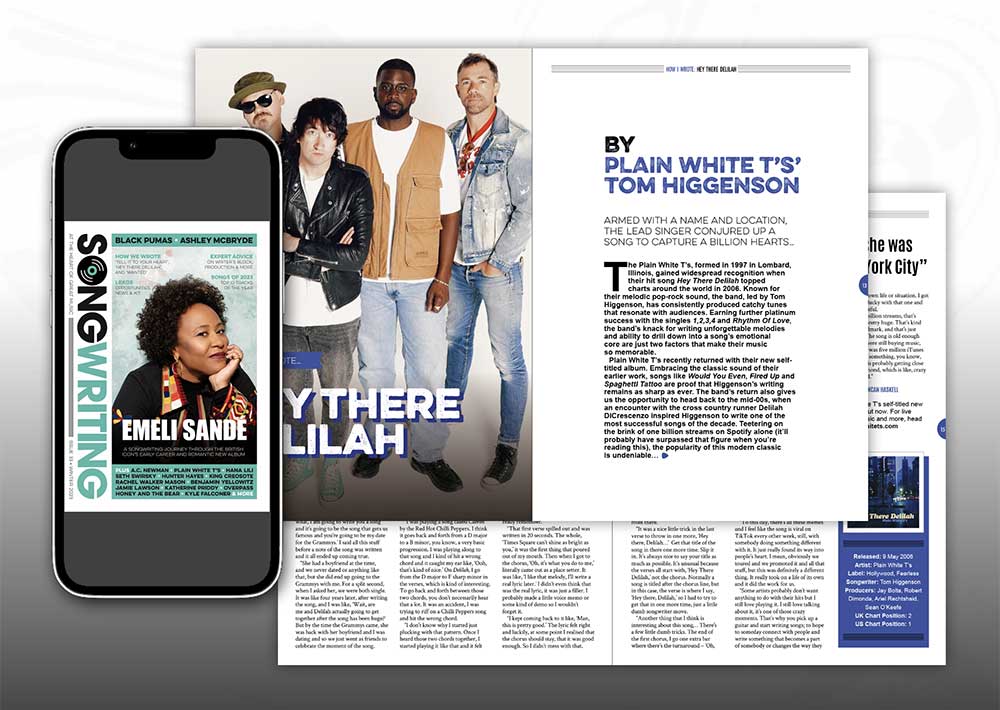
Armed with a name and location, the Illinois band’s lead singer conjured up a song to capture a billion hearts
The Plain White T’s, formed in 1997 in Lombard, Illinois, gained widespread recognition when their hit song Hey There Delilah topped charts around the world in 2006. Known for their melodic pop-rock sound, the band, led by Tom Higgenson, has consistently produced catchy tunes that resonate with audiences. Earning further platinum success with the singles 1,2,3,4 and Rhythm Of Love, the band’s knack for writing unforgettable melodies and ability to drill down into a song’s emotional core are just two factors that make their music so memorable.
Plain White T’s returned with their new self-titled album. Embracing the classic sound of their earlier work, songs like Would You Even, Fired Up and Spaghetti Tattoo are proof that Higgenson’s writing remains as sharp as ever. The band’s return also gives us the opportunity to head back to the mid-00s, when an encounter with the cross-country runner Delilah DiCrescenzo inspired Higgenson to write one of the most successful songs of the decade. Teetering on the brink of one billion streams on Spotify alone (it’ll probably have surpassed that figure when you’re reading this), the popularity of this modern classic is undeniable…
First published in Songwriting Magazine Winter 2023 issue

How we wrote ‘If I Were A Boy’ for Beyoncé by BC Jean
How the global smash started life as a Californian... Read More+How we wrote ‘Ho Hey’ by The Lumineers’ Wesley Schultz
The frontman explains how their breakthrough hit single was inspired by a d... Read More+How I wrote ‘In My Daughter’s Eyes’ for Martina McBride
Written as a gift for his brother, this noughties classic track by James T.... Read More+




Released: 9 May 2006
Artist: Plain White T’s
Label: Hollywood, Fearless
Songwriter: Tom Higgenson
Producers: Jay Bolta, Robert Dimonda, Ariel Rechtshaid, Sean O’Keefe
UK chart position: 2
US chart position: 1
“I met this girl named Delilah. She was really, really pretty, and I hung out with her one night, because she was a friend of a friend. We were hanging out, and at the end of the night, I joked with her that I had a song about her. I was trying to be cute and funny – I’d just met the girl, so it was obviously just a dumb goofy line.
“The very next day after I met her, she went back to school in New York. We kept in touch on AOL Instant Messenger and she kept asking me, ‘Where’s my song? When do I get to hear it?’ And so eventually, I was like, ‘Okay, shit, now I gotta write a song for her.’ Before I wrote a single note of the song, I’d told her like, ‘You know what, I am going to write you a song and it’s going to be the song that gets us famous, and you’re going to be my date for the Grammys.’ I said all this stuff before a note of the song was written, and it all ended up coming true.
“She had a boyfriend at the time, and we never dated or anything like that, but she did end up going to the Grammys with me. For a split second, when I asked her, we were both single. It was like four years later, after writing the song, and I was like, ‘Wait, are me and Delilah actually going to get together after the song has been huge?’ But by the time the Grammys came, she was back with her boyfriend, and I was dating, so we just went as friends to celebrate the moment of the song.
“I gotta check back in with Delilah. I haven’t spoken to her since the pandemic. But yeah, she loved the song. Like I said, she had a boyfriend at the time, and she would come to our shows in New York City to support us. We had a shirt that said, ‘I am Delilah’ that we sold, and she would wear that shirt at the shows. Her boyfriend would wait outside. He was cool with it, but he didn’t want to come in himself, so I never met the boyfriend ever. She got a kick out of the song for sure.
“So that’s the quick story on the inspiration. Now I’m going to geek out a little bit more on the songwriting of it…
A magazine to keep. An archive to explore.
Get the latest edition, 40+ back issues, 3,200+ website articles and expert insights for songwriters
“I was playing a song called Cabron by the Red Hot Chilli Peppers. I think it goes back and forth from a D major to a B minor, you know, a very basic progression. I was playing along to that song, and I kind of hit a wrong chord, and it caught my ear like, ‘Ooh, that’s kind of nice.’ On Delilah, I go from the D major to F sharp minor in the verses, which is kind of interesting. To go back and forth between those two chords, you don’t necessarily hear that a lot. It was an accident, I was trying to riff on a Chilli Peppers song and hit the wrong chord.
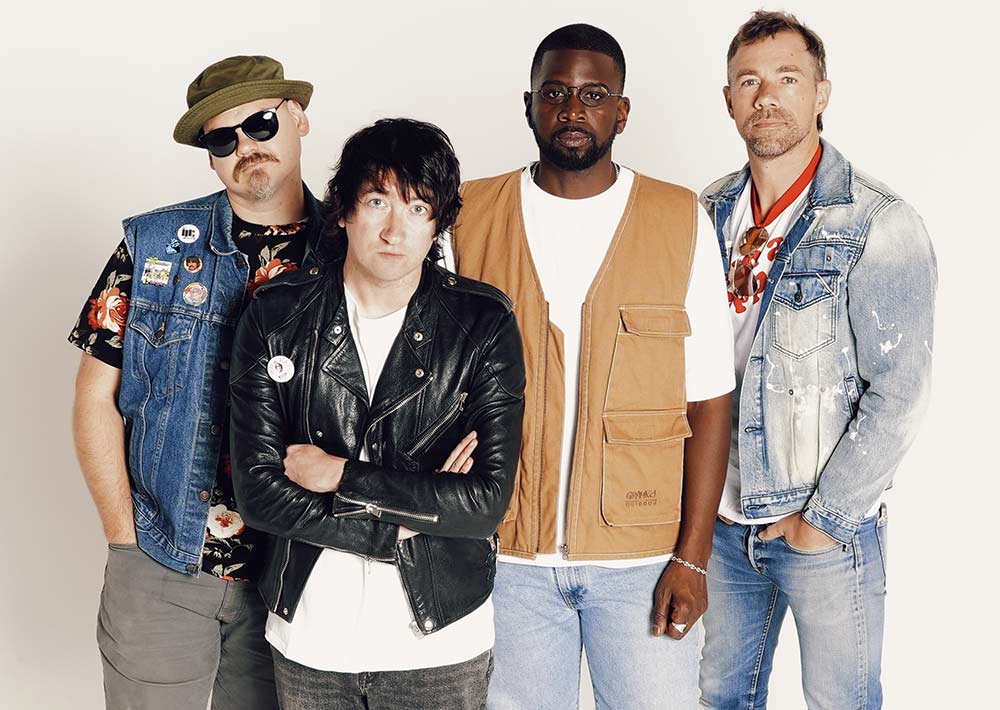
Plain White T’s’ Tom Higgenson: “All I really knew about her was that she was pretty and she went to school in New York City.”
“I don’t know why I started just plucking with that pattern. Once I heard those two chords together, I started playing it like that and it felt nice. I had that little opening riff lying around, and then all this time is the back and forth with Delilah, you know, talking to her.
“I thought if I was going to write her a song, maybe I’d try to use that little guitar part that I had. So I started playing, and I thought of, ‘Hey there, Delilah.’ No idea why, it just came out of my mouth. The whole first verse was literally the first thing that came out of my mouth as I was playing. It was like, ‘Hey there, Delilah.’ ‘Okay,’ ‘What’s it like in New York City?’ I was in Chicago, so you know, ‘I’m 1,000 miles away. But tonight, you look so pretty. Yes, you do.’ And then I changed the chord there. I don’t know why, I don’t really remember.
“That first verse spilled out and was written in 20 seconds. The whole, ‘Times Square can’t shine as bright as you,’ it was the first thing that poured out of my mouth. Then, when I got to the chorus, ‘Oh, it’s what you do to me,’ literally came out as a place setter. It was like, ‘I like that melody, I’ll write a real lyric later.’ I didn’t even think that was the real lyric; it was just a filler. I probably made a little voice memo or some kind of demo so I wouldn’t forget it.

“I kept coming back to it like, ‘Man, this is pretty good.’ The lyric felt right, and luckily, at some point, I realised that the chorus should stay, that it was good enough. So I didn’t mess with that.
“Then it came to a point where it was like, ‘I’ve only really met this girl one night.’ All I really knew about her was that she was pretty and she went to school in New York City. I had already gotten through that. I had that feeling of, ‘This feels really good and these lyrics are maybe a little bit better than some other stuff I’ve written.’ So, again, I didn’t really have anything else to say about this girl, because I didn’t know her. So, for the rest of the song I had to get a little bit more creative and think, ‘If I was in a long-distance relationship with somebody, what would be the perfect things to say?’
“The song shifts from the second verse on to a little bit more of my side of it, like, ‘Someday I’ll pay the bills with this guitar.’ It goes away from the specifics of this girl being far away to my reality of it. So not only did I have to figure out what the hell else to say in the song, but I also knew that those first few lines were really good, so every line in the song now had to be as good and hit that bar. I really did take my time. It took about six months of thinking about what else I could write about this theme of a long-distance relationship. The bridge got to the ‘Planes and trains and cars,’ and it was a simple idea, and I kind of ran with it from there.
“It was a nice little trick in the last verse to throw in one more, ‘Hey there, Delilah…’ Get that title of the song in there one more time. Slip it in. It’s always nice to say your title as much as possible. It’s unusual because the verses all start with, ‘Hey There Delilah,’ not the chorus. Normally, a song is titled after the chorus line, but in this case, the verse is where I say, ‘Hey there, Delilah,’ so I had to try to get that in one more time, just a little dumb songwriter move.
“Another thing that I think is interesting about this song… There are a few little dumb tricks. The end of the first chorus, I go one extra bar where there’s the turnaround – ‘Oh, it’s what you do to me… What you do to me.’ There’s one more, ‘What you do to me,’ where it goes back to the D. Then it stays on the D to start that second verse. Whereas in the end of the second chorus, I don’t have that extra turnaround, it goes straight into the bridge. That’s just my songwriter thing to keep the flow of the song interesting.
“It’s funny, because every time we play it live, at the end of the second chorus, people are always singing, ‘What you do to me,’ and I’m like, ‘No, we’re going straight to the bridge here, people!’ That’s me putting a little bit of a geeky songwriter move in there to help the pace. Little moves like that help to perk up the ear and to make it not boring.
“I have this thought and this mentality that if you do something good enough, like if you write a good enough song, or if you make a good enough movie, or a piece of art, if it really is good enough, you kind of can’t stop it. It will find an audience; it will spread from word of mouth or whatever. That’s what happened with, Hey There Delilah that’s really what happened. We did our part, but the world took that song and the fans made the song.
“To this day, there are all these memes, and I feel like the song is viral on TikTok every other week, still, with somebody doing something different with it. It just really found its way into people’s hearts. I mean, obviously, we toured, and we promoted it and all that stuff, but this was definitely a different thing. It really took on a life of its own and it did the work for us.
“Some artists probably don’t want anything to do with their hits, but I still love playing it. I still love talking about it, it’s one of those crazy moments. That’s why you pick up a guitar and start writing songs; to hope to someday connect with people and write something that becomes a part of somebody or changes the way they look at their own life or situation. I got really, really lucky with that one, and I’m very grateful.
“Hitting a billion streams, that’s going to be pretty huge. That’s kind of a new landmark, and that’s just on Spotify. The song is old enough that people were still buying music. I think there were five million iTunes purchases or something, you know, so that song is probably getting close to being diamond, which is like, crazy level. It’s wild.”
Plain White T’s self-titled new album is out now. For live dates, music and more, head to plainwhitets.com
More Like This
Interview: Tom Higgenson of Plain White T’s
The frontman and chief songwriter discusses his Il... Read More+How we wrote ‘If I Were A Boy’ for Beyoncé by BC Jean
How the global smash started life as a Californian... Read More+How we wrote ‘Ho Hey’ by The Lumineers’ Wesley Schultz
The frontman explains how their breakthrough hit single was inspired by a d... Read More+How I wrote ‘In My Daughter’s Eyes’ for Martina McBride
Written as a gift for his brother, this noughties classic track by James T.... Read More+








More Like This