
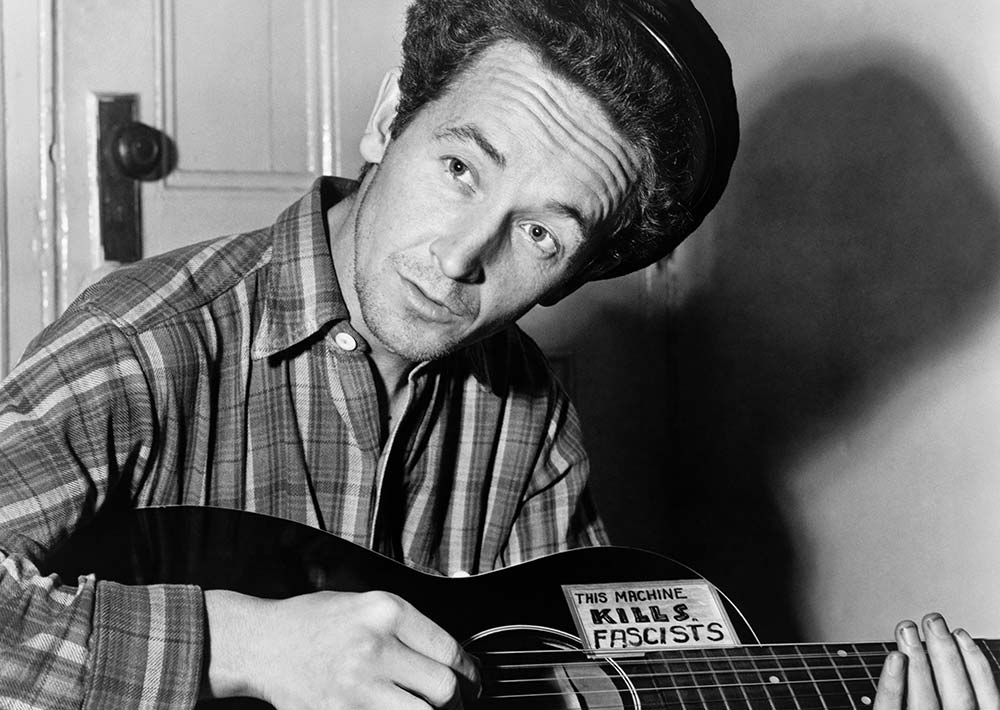
Woody Guthrie, “never did know enough about writing down the notes of music to do any harm.” Photo: Wikimedia Commons/Al Aumuller/New York World-Telegram and the Sun
Broadway actor and musician David Lutken explores 10 songs by one of the most significant figures in American folk music
Woody Sez: The Life & Music of Woody Guthrie is a biography for the stage that I devised along with Nick Corley, Darcie Deaville, Helen Jean Russell and Andy Teirstein. We had our premiere at the Edinburgh Festival Fringe in 2007, and after more than 80 productions worldwide, including an Off-Broadway run in New York, this year we brought the show back to the Edinburgh Festival Fringe before heading to London for a short run in September.
I began learning Woody Guthrie’s songs (along with bits and pieces of his life story) when I was a very young child in Texas. My co-devisers of Woody Sez – Darcie, Helen and Andy, all accomplished multi-instrumentalists across many genres – share my love of and reverence for Guthrie’s singular contribution to the canon of American protest music.
Woody often said that he “made” his songs rather than writing or composing them, because he “never did know enough about writing down the notes of music to do any harm”. He rarely strayed from a time-honoured technique of writing new words to old tunes. Parodists and legitimate artists alike have used this method for centuries – from John Gay and Johann Pepusch reworking Over The Hills And Far Away and other popular tunes in The Beggars’ Opera, to one of Guthrie’s own heroes, the labour movement martyr Joe Hill, who set The Preacher And The Slave to the once-ubiquitous Sally Army hymn In The Sweet By And By. That song’s most famous line – you’ll get pie in the sky when you die – has become so well-worn that Hill’s authorship has been all but lost.
But Woody carries this to his own level – one that few have equalled and certainly none has surpassed. Our musical/autobiographical play seeks to add as much as possible of the dimension and depth that Woody brings to his lyrics from his own observations and experiences, set to well-known melodies. Yet the biggest task we set for ourselves is to show how he lifts terrible weight and tragedy from his own life and creates a musical result so profound and universal that its authorship by an ornery little, tousle-haired Oklahoma yokel is hard to fathom.
Pastures Of Plenty, Union Maid, The Ballad Of Tom Joad and, of course, his most famous song, This Land Is Your Land, are four examples of the method and madness in his songwriting or song-crafting, if you will. Also essential examples of Guthrie’s music and important parts of the show are the songs The Sinking Of The Reuben James, Grand Coulee Dam, Roll On Columbia, The Jolly Banker, I’ve Got To Know and 1913 Massacre.
PASTURES OF PLENTY
One of the greatest patriotic protest songs ever written, it is a unique example of multi-layered meaning in what was part of a promotional effort by the Bonneville Power Administration. Stephen Kahn, a leftist working in public relations for the nascent BPA during the Depression, had a recommendation from the folklorist Alan Lomax to hire Woody to write songs for a documentary film promoting a spectacularly ambitious Columbia River electric power and irrigation project in the Pacific Northwest.
Woody arrived in May of 1941 and produced 26 songs in just 30 days, among them Roll On Columbia (to the tune of Lead Belly’s Irene Goodnight) and Grand Coulee Dam (a modified Wabash Cannonball).
Pastures Of Plenty is a short, quick bundle of verses set to the stark, murder ballad tune of Pretty Polly: the struggle and destruction of the Dust Bowl and the Great Depression become the unerasable theme, overlain with a tough, plain-spoken story about migrant workers who never lose sight of what good government owes everyday people – jobs and a better standard of living, for everyone.

A magazine to keep. An archive to explore.
Get the latest edition, 40+ back issues, 3,200+ website articles and expert insights for songwriters
In his recording on Dust Bowl Ballads, Woody plays only one chord through the minor-modal tune. His lyrics do, very short-sightedly, omit the devastation wreaked upon the natural environment and Native American culture by the harnessing of the rivers’ water and power – issues he would have been aware of, growing up in oil-boom Oklahoma. Still, these five verses and not quite 200 words are hard to escape: the journey of hard-scrabble migrant workers sleeping on the ground, working in every state to provide for everyone. The lyric takes something of an accusatory turn:
I’ve worked in your orchards of peaches and prunes
I’ve slept on the ground in the light of your moon
On the edge of your cities, you’ll see us and then
We come with the dust and we go with the wind.
Yet the subject is: plenty, the land is my land, which I’ll defend with my life, and the singer will work in this fight, and we’ll fight ’til we win. The song shouts for us all to take stock of our as-yet-unequal-but-potentially-utopian country. It is a true tour-de-force of imagery, pronoun placement – it’s always we ramble, that river and I – criticism, self-examination and patriotic fervour.
UNION MAID
This is an example of a 1940s viral hit. Woody and a 21-year-old Pete Seeger were travelling the country singing for strikers and political groups. They met Bob and Ina Wood, Communist Party organisers in Oklahoma, who heard about Annie Mae Merriwether, a marcher on a farm workers’ picket line who had been terribly beaten. Woody wrote lyrics that night to the melody of the extremely popular 1907 song Red Wing, with its romantic lyrics about a beautiful American Indian Maid – one of my grandmother’s favourites!
The version we use in our show, Woody Sez, was first recorded in June of 1940 after some significant softening of Woody’s original lyrics about the brutal event. This song’s continued popularity rests on its perfect hook, which unfortunately obscures its bloody-struggle roots but boosts its staying power as one of the most famous American Union Movement anthems.
THE BALLAD OF TOM JOAD
Written in 1940, while Woody was living in New York City’s East Village, it came after he had seen the John Ford film The Grapes Of Wrath (based on the John Steinbeck novel) multiple times. Woody knew that his choice of the tune Old John Hardy – based on a real bandit hanged for murder in 1894 – would bring with it a widely understood outlaw aura for one of his greatest creations.
Old John Hardy is about a Black railroad worker named John Hardy who was executed for murder in 1894 in McDowell County, West Virginia. According to accounts, he composed the song himself and sang it on the gallows. It’s a song that has become a hit in the folk, old time and bluegrass circles, being covered by artists from Eva Davis to Clarence Ashley to Lonnie Donegan, Tony Rice, Béla Fleck and Billy Strings.
Woody uses the melody as the canvas on which to paint his indelible portrait of Steinbeck’s Everyman. Steinbeck himself is said to have told Woody: “You wrote my whole novel in 17 verses!” They are accurate to the film and to a good deal of the novel, but Guthrie saw his own life in the story too. One of its final verses says:
Tom run back to where his mama was asleep,
Woke her up out of the bed, and he
Kissed goodbye to the mother that he loved.
Woody’s mother, Nora Belle, of whom he wrote often and with profound and touching affection – he credited her with his love of music – had died from Huntington’s disease. Huntington’s is a hereditary degenerative nerve disorder, often undiagnosed until middle age, for which there is no cure. It weighed upon him, particularly one heartbreaking episode when he was 14, visiting her as she lay restrained, and she looked at him and said only: “You’re Woodrow”, before turning away.
I believe Woody sees himself in Tom Joad’s place – a man pursued by his mother’s killer, running back to wake her and sing to her what he wants to do with his own life and his songs:
Everybody might be just one big soul,
well it looks that-a-way to me.
Everywhere that you look in the day or the night,
That’s where I’m gonna be, ma. That’s where I’m gonna be.


Songs In The Key Of… Wilco
With a comprehensive new book about Jeff Tweedy’s ... Read More+How I wrote ‘American Pie’ by Don McLean
The singer-songwriter aimed to craft “a big song” ... Read More+Songs In The Key Of… Leonard Cohen
Harry Freedman, the author of a brilliant new book on the singer-songwriter... Read More+


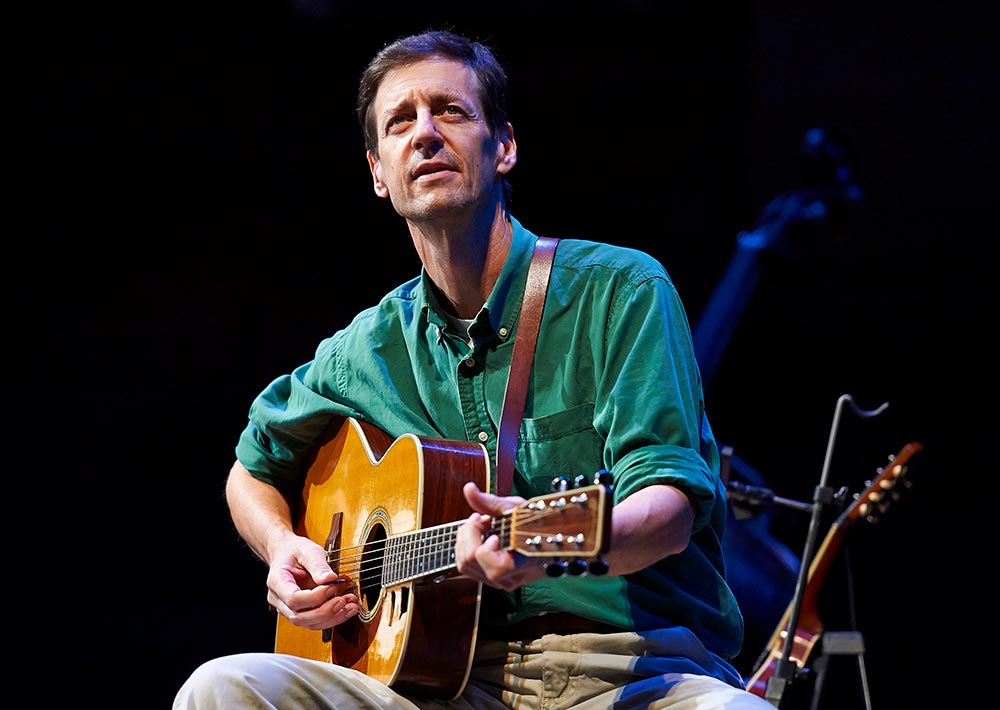
David Lutken performing Woody Sez: The Life And Music Of Woody Guthrie. Photo: Roger Mastroianni
THE SINKING OF THE REUBEN JAMES
The Almanac Singers – made up of Millard Lampell, Lee Hays, Pete Seeger, Woody Guthrie, Sis Cunningham, Bess Lomax, Butch Hawes and more – were a group dedicated to writing topical, political songs. In 1941, with the United States officially “neutral” in the war, Bess Lomax recalled Woody summing up their conundrum in a line:
I set out to write a song for the entire population
But no sooner than I got the words down
Here comes a brand new situation
And then, at dawn on 31 October, a German U-Boat torpedoed and sank the destroyer USS Reuben James, off the coast of Iceland. Of the ship’s 144-person crew, 44 sailors survived. The Almanacs came together to write. Woody, leading the way with his elegiac lyrics – the verse to the tune of Wildwood Flower (originally written in 1860 by J. P. Webster and Maud Irving, and brought back to prominence in the late 1920s by the Carter Family) – wanted to incorporate the names of the dead as a part of his commemoration. He eventually accepted that rhyming 100 names would be impossible, and because of that, landed on the song’s emotional and profound chorus, with its original and brilliantly complementary tune:
Tell me what were their names
Tell me what were their names
Did you have a friend
On the good Reuben James
Recorded and released in 1942, it quickly became famous, and unlike most of the Almanacs’ exhortations for the non-violent struggle against ‘man’s inhumanity to man’, this song became an American call to arms soon after the United States finally entered WWII, just over five weeks after the Reuben James was sunk, when a further 2,400 Americans were killed in the Japanese attack on Pearl Harbor.
GRAND COULEE DAM / ROLL ON COLUMBIA
Woody’s famous burst of creativity in the Pacific Northwest – 26 songs in 30 days, in the late spring of 1941 – has gone down in songwriting history. He used the materials at hand: the sights, sounds and people connected to the vast projects of the Bonneville Power Administration, and the tools he brought along – his guitar, his repertoire of melodies and his genius as a lyricist. He did more than just complete his assignment of writing music for a documentary about the BPA. The results of this flood of inspiration speak and sing for themselves.
I’ve written elsewhere about the serious lapses in consideration that a modern eye exposes in the cultural and environmental impact of this electrification project, but the songs’ combining of imagery, melody and purpose shine through every couplet.
Grand Coulee Dam is Woody’s modified melody of The Wabash Cannonball:
Now the world holds seven wonders that the travelers always tell,
Some gardens and some towers, I guess you know them well,
But now the greatest wonder is in Uncle Sam’s fair land.
It’s the King Columbia River and the big Grand Coulee Dam.
This song crosses over toward “jingoistic”, but its super-positivity and nature-conquering attitude might be attributed to the atmosphere not only of impending war, but Guthrie’s own recent past of watching drought and dust storms destroy lives and livelihoods. This song wound up in the long-delayed documentary when the film was finished in 1949, and, in 1958, recorded by a young British skiffle singer named Lonnie Donegan – that somewhat febrile version is sometimes said to have caught 17-year-old Bobby Zimmerman’s ear…
Woody often said that Lead Belly was the greatest of them all, and Roll On Columbia turned into one of his most enduring and popular works, set to Lead Belly’s Irene Goodnight. Guthrie’s lyrics are purposeful and grandiose, capturing the propaganda but never losing touch with the wealth-sharing premise of FDR’s New Deal:
At Bonneville now there are ships in the locks
The waters have risen and cleared all the rocks
Shiploads of plenty will steam past the docks
…and:
On up the river is the Grand Coulee dam
The mightiest thing ever built by a man
To run the great factories and water the land
Roll On Columbia, Roll On was designated Washington State’s official folk song in 1987.
Your power is turning our darkness to dawn
Roll on Columbia, roll on!
THE JOLLY BANKER
In the later 1930s, drought and the Depression pushed hundreds of thousands of internal immigrants toward California, Woody among them. His skill as an improvisational musician and on-air humorist gained him a job and a following in Los Angeles on KFVD radio, where he and his singing partner, Maxine “Lefty Lou” Crissman, would play, sing and reminisce about farm life – in many respects building on the popularity of fellow Oklahoman Will Rogers, whose extemporaneous style and homespun humour had already made him a national figure. One of Rogers’ favourite targets for head-nodding laughs was banks and bankers: “If borrowin’ ain’t a sucker’s game, how come the Banker’s always the richest man in town?”
Woody had taken this to a new level with songs like Pretty Boy Floyd:
As through this world I ramble, I see lots of funny men
Some will rob you with a six-gun and some with a fountain pen.
The Jolly Banker is Guthrie emulating Rogers in a song. The tune is essentially Molly Malone with its fishmonger’s cry:
Alive, alive-oh, alive, alive-oh
Crying cockles and mussels alive, alive-oh
…but Molly Malone is also a song about a working-class heroine, silenced but not unheard. In Woody’s stinging satire, the singer is now the Banker hawking his wares in the marketplace:
I’m a Jolly Banker
A Jolly Banker am I
…telling his customers his many functions and accomplishments, in silly lyrics dripping with the author’s deep disdain and sarcasm:
If you show me you need it
I’ll let you have credit…
Just bring me back two
For every one I lend you!
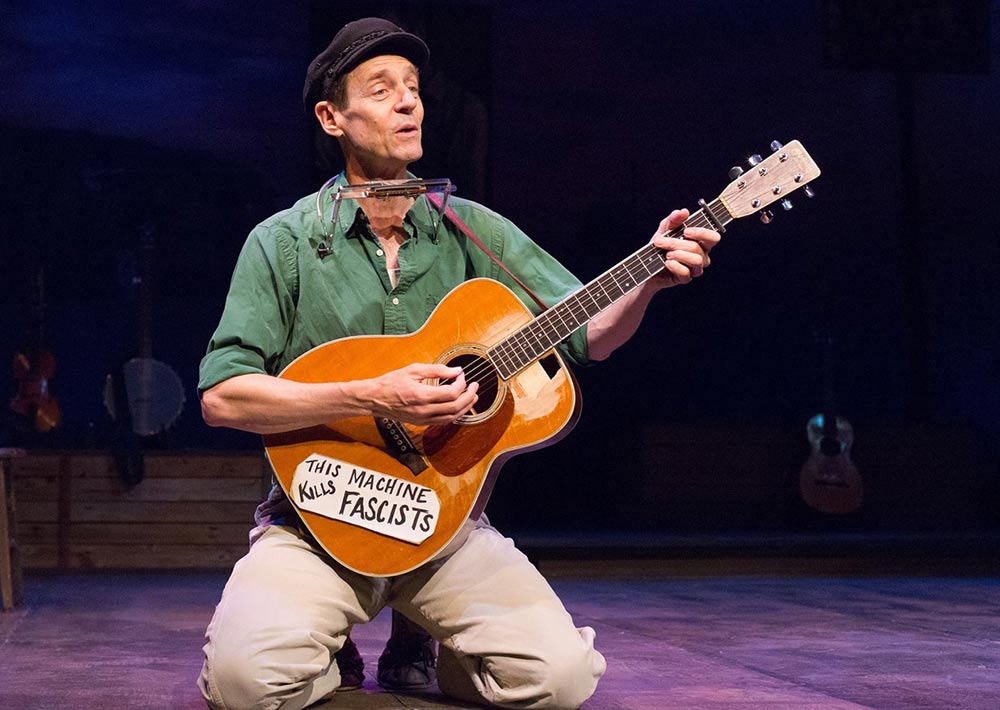
David Lutken: “[1913 Massacre] is perhaps the most perfect example of a song in the key of Woody Guthrie.” Photo: Roger Mastroianni
I’VE GOT TO KNOW
An anthem-like song from later in his career, this one shows Woody’s genius for choice of melody. Farther Along was a hymn heard often through the open doors of rural churches in the 1920s and 30s, particularly in the Southern United States. The verses wonder aloud about the unpunished sins of those “living so wicked year after year”, while the true and faithful are often suffering. The chorus reassures the singer that:
Farther along we’ll know all about it
Farther along we’ll understand why
Cheer up my brothers,
Come live in the sunshine
We’ll understand it all by and by
In his scathing indictment of corporate greed, Woody upends the hymn’s meek intent and reverses who’s asking what of whom:
Why can’t my two hands get a good pay job?
I can still plow, plant, I can still sow
Why did your lawbook chase me off my good land
I’d sure like to know, friend, I’ve got to know!
Instead of asking a preacher or authority figure about other people’s sins, this song puts the little guy in charge of a direct interrogation of the perpetrator:
Why do the cops kill my trade union workers
You’re gonna have to talk plain, sir,
‘Cause I sure got to know.
His use of this specific hymn’s melody is integral to the song’s meaning – there is no farther along here; right now is when I’ve Got to Know.
1913 MASSACRE
Unlike Pretty Boy Floyd’s “Come gather round me children and a story I will tell”, this song carries us along on the journey itself. We are invited to…
Take a trip with me in 1913
To Calumet, Michigan in copper country
…to be in the Italian Hall on that terrible December night. Woody was inspired by the eyewitness account of organiser and activist Ella Reeve ‘Mother’ Bloor in her memoir, We Are Many, and his story subtly shifts from sights, sounds and action to narration and back again. “I will take you”, he sings, around the holiday party, seeing children and decorations as if with our own eyes, meeting – even speaking with – other guests:
There’s talking and laughing and songs in the air
And the spirit of Christmas is there everywhere
Before you know it you’re friends with us all
And you’re dancing – – – around and around in the hall.
The tune is close to the traditional ballad The Nightingale. Nora Belle Guthrie, Woody’s mother, played piano, and I believe it’s a ballad she might have sung – perhaps I’m swayed by the imagery of parents and children…
Well a little girl sits down by the Christmas tree lights
To play the piano so you gotta keep quiet
…and the Christmas Story is, after all, one of a mother and child. But whatever the origins, his austere, beautifully understated guitar accompaniment and the resulting melody are all his own, and as deceptively nuanced as his lyric’s documentary approach and immediacy.
As the thugs plot their slaughter outside in secret, neither the chords nor the tune shift or signal the coming disaster, and lyrically, when the murderous joke is set in motion and so many are crushed to death, these children become ours:
We carried our children back up to the tree
The scabs outside still laughed at their spree
Listen to the aching clash between his voice – holding his plaintive B-note – against the three rolling notes of his guitar’s F# in the final lines of the last two verses:
And the children – – – who died there were seventy-three.
…and again as the singer and his grieving community implore the murderers:
The parents they cried and the miners they moaned
See what – – – your greed for money has done.
This is perhaps the most perfect example of a song in the key of Woody Guthrie.
THIS LAND IS YOUR LAND
Much has been written about Woody’s most famous and enduring song. The melody comes from a traditional Baptist hymn, When The World’s On Fire:
Oh, my loving brother, when the world’s on fire
Don’t you want God’s bosom, to be your pillow?
Hide me over in the Rock of Ages,
Rock of Ages, cleft for me.
On 23 February of 1940, Woody had newly arrived in New York City, having made his way across the country from California, hearing Irving Berlin’s then-ubiquitous God Bless America along the way. Camped in a rooming house on 43rd St., he wrote six verses of what became an unofficial American national anthem – his original final line, “God blessed America for me!”, scratched out and replaced with the tag we know now. He wrote it as a response to Berlin’s song, thinking that it had been common, everyday people’s faith in one another that “blessed America”. Across the bottom of the page, he wrote: “All you can write is what you see.”
For several years, the three most radical verses were removed from almost all published or cover versions, in reaction to the Blacklist era in America. Woody’s own decline from Huntington’s disease began in the early 1950s, but in spite of it all, his song kept on, as he might have said.
Woody Guthrie wouldn’t have been forgotten without it, but it continues to sweep across the world of musical art with an ebb and flow directly related to how much of the world seems to be on fire.
Nobody living can ever stop me
As I go walking my freedom highway
Nobody living can make me turn back.
This land was made for you and me.
Woody Sez: The Life & Music of Woody Guthrie will be performed at London’s Underbelly Boulevard in Soho from 8-19 September. For tickets and more information, visit: underbellyboulevard.com
More Like This
‘This Land’ by Whetherman (Album)
It’s well worth listening to troubadour Nicholas W... Read More+Songs In The Key Of… Wilco
With a comprehensive new book about Jeff Tweedy’s ... Read More+How I wrote ‘American Pie’ by Don McLean
The singer-songwriter aimed to craft “a big song” ... Read More+Songs In The Key Of… Leonard Cohen
Harry Freedman, the author of a brilliant new book on the singer-songwriter... Read More+










More Like This