

Discover The Recording Academy’s Songwriters & Composers Wing in Songwriting Magazine Spring 2026
How the organisation behind the Grammys is championing the creators who are shaping the future of music around the world
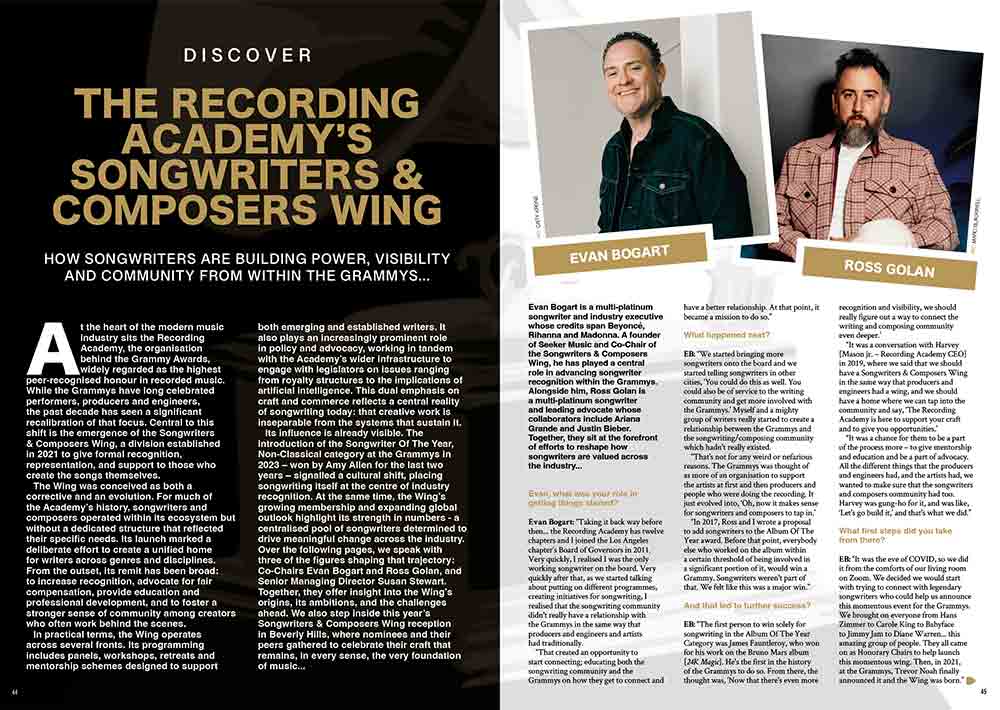
At the heart of the modern music industry sits the Recording Academy, the organisation behind the Grammy Awards, widely regarded as the highest peer-recognised honour in recorded music. While the Grammys have long celebrated performers, producers and engineers, the past decade has seen a significant recalibration of that focus. Central to this shift is the emergence of the Songwriters & Composers Wing, a division established in 2021 to give formal recognition, representation, and support to those who create the songs themselves.
The Wing was conceived as both a corrective and an evolution. For much of the Academy’s history, songwriters and composers operated within its ecosystem but without a dedicated structure that reflected their specific needs. Its launch marked a deliberate effort to create a unified home for writers across genres and disciplines. From the outset, its remit has been broad: to increase recognition, advocate for fair compensation, provide education and professional development, and to foster a stronger sense of community among creators who often work behind the scenes.
In practical terms, the Wing operates across several fronts. Its programming includes panels, workshops, retreats and mentorship schemes designed to support both emerging and established writers. It also plays an increasingly prominent role in policy and advocacy, working in tandem with the Academy’s wider infrastructure to engage with legislators on issues ranging from royalty structures to the implications of artificial intelligence. This dual emphasis on craft and commerce reflects a central reality of songwriting today: that creative work is inseparable from the systems that sustain it.
Its influence is already visible. The introduction of the Songwriter Of The Year, Non-Classical category at the Grammys in 2023 – won by Amy Allen for the last two years – signalled a cultural shift, placing songwriting itself at the centre of industry recognition. At the same time, the Wing’s growing membership and expanding global outlook highlight its strength in numbers – a centralised pool of songwriters determined to drive meaningful change across the industry. Over the following pages, we speak with three of the figures shaping that trajectory: Co-Chairs Evan Bogart and Ross Golan, and Senior Managing Director Susan Stewart. Together, they offer insight into the Wing’s origins, its ambitions, and the challenges ahead. We also step inside this year’s Songwriters & Composers Wing reception in Beverly Hills, where nominees and their peers gathered to celebrate their craft that remains, in every sense, the very foundation of music…
Originally published in Songwriting Magazine Spring 2026
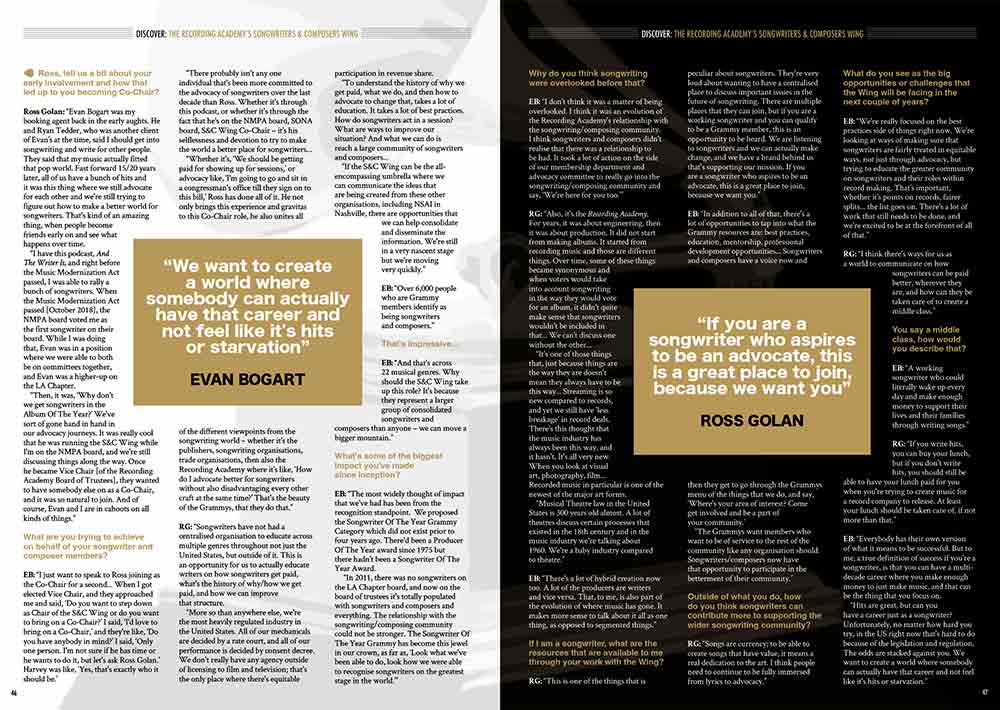
Evan Bogart & Ross Golan
Evan Bogart is a multi-platinum songwriter and industry executive whose credits span Beyoncé, Rihanna and Madonna. A founder of Seeker Music and Co-Chair of the Songwriters & Composers Wing, he has played a central role in advancing songwriter recognition within the Grammys. Alongside him, Ross Golan is a multi-platinum songwriter and leading advocate whose collaborators include Ariana Grande and Justin Bieber. Together, they sit at the forefront of efforts to reshape how songwriters are valued across the industry…
We want to create a world where somebody can actually have that career and not feel like it’s hits or starvation
Evan, what was your role in getting things started?
Evan Bogart: “Taking it back way before then… the Recording Academy has 12 chapters and I joined the Los Angeles chapter’s Board of Governors in 2011. Very quickly, I realised I was the only working songwriter on the board. Very quickly after that, as we started talking about putting on different programmes, creating initiatives for songwriting, I realised that the songwriting community didn’t really have a relationship with the Grammys in the same way that producers and engineers and artists had traditionally.
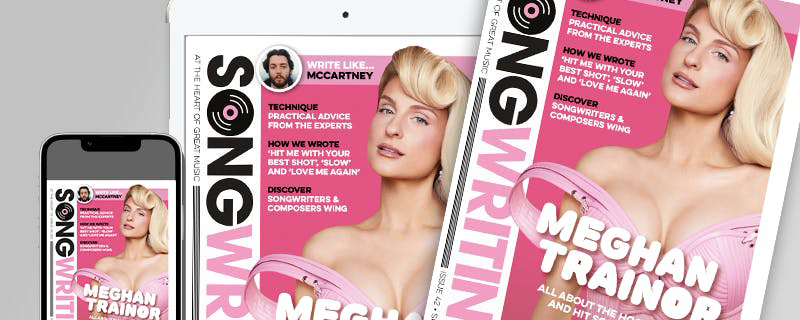
A magazine to keep. An archive to explore.
Get the latest edition, 40+ back issues, 3,200+ website articles and expert insights for songwriters
“That created an opportunity to start connecting; educating both the songwriting community and the Grammys on how they get to connect and have a better relationship. At that point, it became a mission to do so.”
What happened next?
EB: “We started bringing more songwriters onto the board and we started telling songwriters in other cities, ‘You could do this as well. You could also be of service to the writing community and get more involved with the Grammys.’ Myself and a mighty group of writers really started to create a relationship between the Grammys and the songwriting/composing community which hadn’t really existed.
“That’s not for any weird or nefarious reasons. The Grammys was thought of as more of an organisation to support the artists at first and then producers and people who were doing the recording. It just evolved into, ‘Oh, now it makes sense for songwriters and composers to tap in.’
“In 2017, Ross and I wrote a proposal to add songwriters to the Album Of The Year award. Before that point, everybody else who worked on the album within a certain threshold of being involved in a significant portion of it, would win a Grammy. Songwriters weren’t part of that. We felt like this was a major win.”
And that led to further success?
EB: “The first person to win solely for songwriting in the Album Of The Year Category was James Fauntleroy, who won for his work on the Bruno Mars album [24K Magic]. He’s the first in the history of the Grammys to do so. From there, the thought was, ‘Now that there’s even more recognition and visibility, we should really figure out a way to connect the writing and composing community even deeper.’
“It was a conversation with Harvey [Mason Jr. – Recording Academy CEO] in 2019, where we said that we should have a Songwriters & Composers Wing in the same way that producers and engineers had a wing, and we should have a home where we can tap into the community and say, ‘The Recording Academy is here to support your craft and to give you opportunities.’
“It was a chance for them to be a part of the process more – to give mentorship and education and be a part of advocacy. All the different things that the producers and engineers had, and the artists had, we wanted to make sure that the songwriters and composers community had too. Harvey was gung-ho for it, and was like, ‘Let’s go build it,’ and that’s what we did.”

How we wrote Maren Morris’ ‘The Bones’ by Laura Veltz
The Country Music Association Song of the Year that was inspired by a real ... Read More+Songwriting Magazine Issue 42
Meghan Trainor, Amy Grant, Bastian Langebæk, John ... Read More+Member Profile: Fiona Ross
Among 2020’s 100 Alternative Power Music List, multi-award-winning ja... Read More+



Discover The Recording Academy’s Songwriters & Composers Wing in Songwriting Magazine Spring 2026
What first steps did you take from there?
EB: “It was the eve of COVID, so we did it from the comforts of our living room on Zoom. We decided we would start with trying to connect with legendary songwriters who could help us announce this momentous event for the Grammys. We brought on everyone from Hans Zimmer to Carole King to Babyface to Jimmy Jam to Diane Warren… this amazing group of people. They all came on as Honorary Chairs to help launch this momentous wing. Then, in 2021, at the Grammys, Trevor Noah finally announced it and the Wing was born.”
Ross, tell us a bit about your early involvement and how that led up to you becoming Co-Chair?
Ross Golan: “Evan Bogart was my booking agent back in the early aughts. He and Ryan Tedder, who was another client of Evan’s at the time, said I should get into songwriting and write for other people. They said that my music actually fitted that pop world. Fast forward 15/20 years later, all of us have a bunch of hits and it was this thing where we still advocate for each other and we’re still trying to figure out how to make a better world for songwriters. That’s kind of an amazing thing, when people become friends early on and see what happens over time.
“I have this podcast, And The Writer Is, and right before the Music Modernization Act passed, I was able to rally a bunch of songwriters. When the Music Modernization Act passed [October 2018], the NMPA board voted me as the first songwriter on their board. While I was doing that, Evan was in a position where we were able to both be on committees together, and Evan was a higher-up on the LA Chapter.
“Then, it was, ‘Why don’t we get songwriters in the Album Of The Year?’ We’ve sort of gone hand in hand in our advocacy journeys. It was really cool that he was running the S&C Wing while I’m on the NMPA board, and we’re still discussing things along the way. Once he became Vice Chair [of the Recording Academy Board of Trustees], they wanted to have somebody else on as a Co-Chair, and it was so natural to join. And of course, Evan and I are in cahoots on all kinds of things.”
What are you trying to achieve on behalf of your songwriter and composer members?
EB: “I just want to speak to Ross joining as the Co-Chair for a second… When I got elected Vice Chair, and they approached me and said, ‘Do you want to step down as Chair of the S&C Wing or do you want to bring on a Co-Chair?’ I said, ‘I’d love to bring on a Co-Chair,’ and they’re like, ‘Do you have anybody in mind?’ I said, ‘Only one person. I’m not sure if he has time or he wants to do it, but let’s ask Ross Golan.’ Harvey was like, ‘Yes, that’s exactly who it should be.’
“There probably isn’t any one individual that’s been more committed to the advocacy of songwriters over the last decade than Ross. Whether it’s through this podcast, or whether it’s through the fact that he’s on the NMPA board, SONA board, S&C Wing Co-Chair – it’s his selflessness and devotion to try to make the world a better place for songwriters…
“Whether it’s, ‘We should be getting paid for showing up for sessions,’ or advocacy like, ‘I’m going to go and sit in a congressman’s office till they sign on to this bill,’ Ross has done all of it. He not only brings this experience and gravitas to this Co-Chair role, he also unites all of the different viewpoints from the songwriting world – whether it’s the publishers, songwriting organisations, trade organisations, then also the Recording Academy where it’s like, ‘How do I advocate better for songwriters without also disadvantaging every other craft at the same time?’ That’s the beauty of the Grammys, that they do that.”
RG: “Songwriters have not had a centralised organisation to educate across multiple genres throughout not just the United States, but outside of it. This is an opportunity for us to actually educate writers on how songwriters get paid, what’s the history of why/how we get paid, and how we can improve that structure.
“More so than anywhere else, we’re the most heavily regulated industry in the United States. All of our mechanicals are decided by a rate court, and all of our performance is decided by consent decree. We don’t really have any agency outside of licensing to film and television; that’s the only place where there’s equitable participation in revenue share.
“To understand the history of why we get paid, what we do, and then how to advocate to change that, takes a lot of education. It takes a lot of best practices.”
How do songwriters act in a session? What are ways to improve our situation? And what we can do is reach a large community of songwriters and composers…
“If the S&C Wing can be the all-encompassing umbrella where we can communicate the ideas that are being created from these other organisations, including NSAI in Nashville, there are opportunities that we can help consolidate and disseminate the information. We’re still in a very nascent stage but we’re moving very quickly.”
EB: “Over 6,000 people who are Grammy members identify as being songwriters and composers.”
That’s impressive…
EB: “And that’s across 22 musical genres. Why should the S&C Wing take up this role? It’s because they represent a larger group of consolidated songwriters and composers than anyone – we can move a bigger mountain.”
What’s some of the biggest impact you’ve made since inception?
EB: “The most widely thought of impact that we’ve had has been from the recognition standpoint. We proposed the Songwriter Of The Year Grammy Category, which did not exist prior to four years ago. There’d been a Producer Of The Year award since 1975 but there hadn’t been a Songwriter Of The Year Award.
“In 2011, there were no songwriters on the LA Chapter board, and now on the board of trustees it’s totally populated with songwriters and composers and everything. The relationship with the songwriting/composing community could not be stronger. The Songwriter Of The Year Grammy has become this jewel in our crown, as far as, ‘Look what we’ve been able to do, look how we were able to recognise songwriters on the greatest stage in the world.’”
Why do you think songwriting were overlooked before that?
EB: “I don’t think it was a matter of being overlooked. I think it was an evolution of the Recording Academy’s relationship with the songwriting/composing community. I think songwriters and composers didn’t realise that there was a relationship to be had. It took a lot of action on the side of our membership department and advocacy committee to really go into the songwriting/composing community and say, ‘We’re here for you too.’”
RG: “Also, it’s the Recording Academy. For years, it was about engineering, then it was about production. It did not start from making albums. It started from recording music and those are different things. Over time, some of these things became synonymous and when voters would take into account songwriting in the way they would vote for an album, it didn’t quite make sense that songwriters wouldn’t be included in that… We can’t discuss one without the other…
“It’s one of those things that, just because things are the way they are doesn’t mean they always have to be this way… Streaming is so new compared to records, and yet we still have ‘less breakage’ in record deals. There’s this thought that the music industry has always been this way, and it hasn’t. It’s all very new. When you look at visual art, photography, film… Recorded music in particular is one of the newest of the major art forms.
“Musical Theatre law in the United States is 300 years old, almost. A lot of theatres discuss certain processes that existed in the 18th century and in the music industry we’re talking about 1960. We’re a baby industry compared to theatre.”
EB: “There’s a lot of hybrid creation now too. A lot of the producers are writers and vice versa. That, to me, is also part of the evolution of where music has gone. It makes more sense to talk about it all as one thing, as opposed to segmented things.”
If I am a songwriter, what are the resources that are available to me through your work with the Wing?
RG: “This is one of the things that is peculiar about songwriters. They’re very loud about wanting to have a centralised place to discuss important issues in the future of songwriting. There are multiple places that they can join, but if you are a working songwriter and you can qualify to be a Grammy member, this is an opportunity to be heard. We are listening to songwriters and we can actually make change, and we have a brand behind us that’s supporting our mission. If you are a songwriter who aspires to be an advocate, this is a great place to join, because we want you.”
EB: “In addition to all of that, there are a lot of opportunities to tap into what the Grammy resources are: best practices, education, mentorship, professional development opportunities… Songwriters and composers have a voice now and then they get to go through the Grammys menu of the things that we do, and say, ‘Where’s your area of interest? Come get involved and be a part of your community.’
“The Grammys want members who want to be of service to the rest of the community like any organisation should. Songwriters/composers now have that opportunity to participate in the betterment of their community.”
Outside of what you do, how do you think songwriters can contribute more to supporting the wider songwriting community?
RG: “Songs are currency; to be able to create songs that have value, it means a real dedication to the art. I think people need to continue to be fully immersed from lyrics to advocacy.”
What do you see as the big opportunities or challenges that the Wing will be facing in the next couple of years?
EB: “We’re really focused on the best practices side of things right now. We’re looking at ways of making sure that songwriters are fairly treated in equitable ways, not just through advocacy, but trying to educate the greater community on songwriters and their roles within record-making. That’s important, whether it’s points on records, fairer splits… the list goes on. There’s a lot of work that still needs to be done, and we’re excited to be at the forefront of all of that.”
RG: “I think there are ways for us as a world to communicate on how songwriters can be paid better, wherever they are, and how can they be taken care of to create a middle class.”
You say a middle class, how would you describe that?
EB: “A working songwriter who could literally wake up every day and make enough money to support their lives and their families through writing songs.”
RG: “If you write hits, you can buy your lunch, but if you don’t write hits, you should still be able to have your lunch paid for you when you’re trying to create music for a record company to release. At least your lunch should be taken care of, if not more than that.”
EB: “Everybody has their own version of what it means to be successful. But to me, a true definition of success if you’re a songwriter, is that you can have a multi-decade career where you make enough money to just make music, and that can be the thing that you focus on.
“Hits are great, but can you have a career just as a songwriter? Unfortunately, no matter how hard you try, in the US right now that’s hard to do because of the legislation and regulation. The odds are stacked against you. We want to create a world where somebody can actually have that career and not feel like it’s hits or starvation.”
Discover The Recording Academy’s Songwriters & Composers Wing in Songwriting Magazine Spring 2026
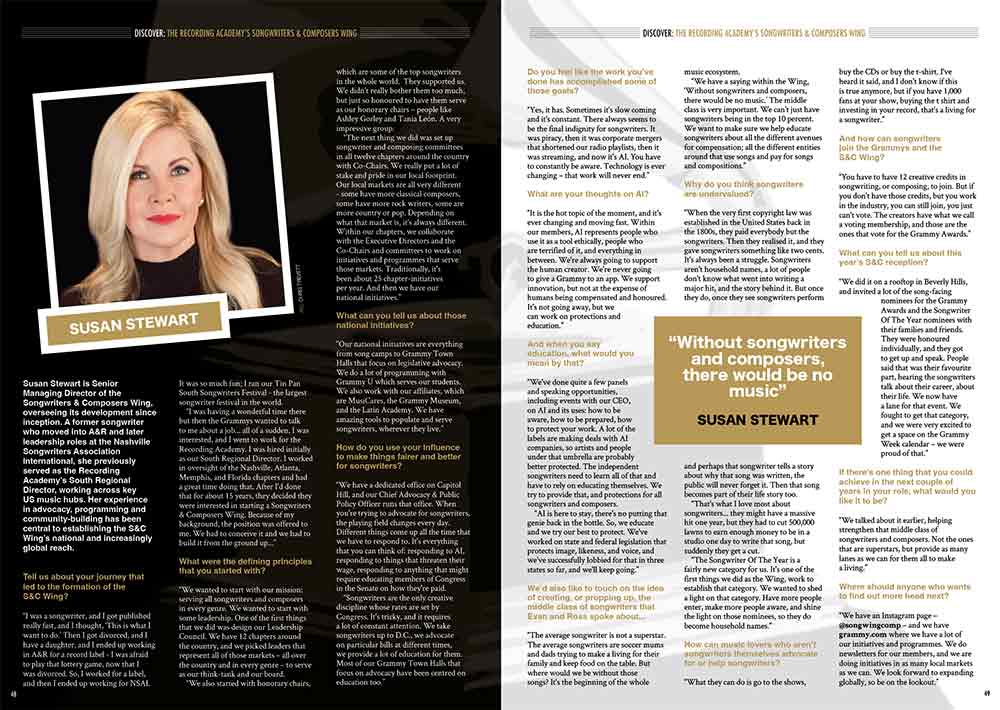
Susan Stewart
Susan Stewart is Senior Managing Director of the Songwriters & Composers Wing, overseeing its development since inception. A former songwriter who moved into A&R and later leadership roles at the Nashville Songwriters Association International, she previously served as the Recording Academy’s South Regional Director, working across key US music hubs. Her experience in advocacy, programming and community-building has been central to establishing the S&C Wing’s national and increasingly global reach.
Without songwriters and composers, there would be no music
Tell us about your journey that led to the formation of the S&C Wing?
“I was a songwriter, and I got published really fast, and I thought, ‘This is what I want to do.’ Then I got divorced, and I have a daughter, and I ended up working in A&R for a record label – I was afraid to play that lottery game, now that I was divorced. So, I worked for a label, and then I ended up working for NSAI. It was so much fun; I ran our Tin Pan South Songwriters Festival – the largest songwriter festival in the world.
“I was having a wonderful time there but then the Grammys wanted to talk to me about a job… all of a sudden, I was interested, and I went to work for the Recording Academy. I was hired initially as our South Regional Director. I worked in oversight of the Nashville, Atlanta, Memphis, and Florida chapters and had a great time doing that. After I’d done that for about 15 years, they decided they were interested in starting a Songwriters & Composers Wing. Because of my background, the position was offered to me. We had to conceive it and we had to build it from the ground up…”
What were the defining principles that you started with?
“We wanted to start with our mission: serving all songwriters and composers in every genre. We wanted to start with some leadership. One of the first things that we did was design our Leadership Council. We have 12 chapters around the country, and we picked leaders that represent all of those markets – all over the country and in every genre – to serve as our think-tank and our board.
“We also started with honorary chairs, which are some of the top songwriters in the whole world. They supported us. We didn’t really bother them too much, but just so honoured to have them serve as our honorary chairs – people like Ashley Gorley and Tania León. A very impressive group.
“The next thing we did was set up songwriter and composing committees in all twelve chapters around the country with Co-Chairs. We really put a lot of stake and pride in our local footprint. Our local markets are all very different – some have more classical composers, some have more rock writers, some are more country or pop. Depending on what that market is, it’s always different. Within our chapters, we collaborate with the Executive Directors and the Co-Chairs and committees to work on initiatives and programmes that serve those markets. Traditionally, it’s been about 25 chapter initiatives per year. And then we have our
national initiatives.”
What can you tell us about those national initiatives?
“Our national initiatives are everything from song camps to Grammy Town Halls that focus on legislative advocacy. We do a lot of programming with Grammy U, which serves our students. We also work with our affiliates, which are MusiCares, the Grammy Museum, and the Latin Academy. We have amazing tools to populate and serve songwriters, wherever they live.”
How do you use your influence to make things fairer and better for songwriters?
“We have a dedicated office on Capitol Hill, and our Chief Advocacy & Public Policy Officer runs that office. When you’re trying to advocate for songwriters, the playing field changes every day. Different things come up all the time that we have to respond to. It’s everything that you can think of: responding to AI, responding to things that threaten their wage, responding to anything that might require educating members of Congress in the Senate on how they’re paid. “Songwriters are the only creative discipline whose rates are set by Congress. It’s tricky, and it requires a lot of constant attention. We take songwriters up to D.C., we advocate on particular bills at different times, we provide a lot of education for them. Most of our Grammy Town Halls that focus on advocacy have been centred on education too.”
Do you feel like the work you’ve done has accomplished some of those goals?
“Yes, it has. Sometimes it’s slow coming and it’s constant. There always seems to be the final indignity for songwriters. It was piracy, then it was corporate mergers that shortened our radio playlists, then it was streaming, and now it’s AI. You have to constantly be aware. Technology is ever changing – that work will never end.”
What are your thoughts on AI?
“It is the hot topic of the moment, and it’s ever-changing and moving fast. Within our members, AI represents people who use it as a tool ethically, people who are terrified of it, and everything in between. We’re always going to support the human creator. We’re never going to give a Grammy to an app. We support innovation, but not at the expense of humans being compensated and honoured. It’s not going away, but we can work on protections and education.”
And when you say education, what would you mean by that?
“We’ve done quite a few panels and speaking opportunities, including events with our CEO, on AI and its uses: how to be aware, how to be prepared, how to protect your work. A lot of the labels are making deals with AI companies, so artists and people under that umbrella are probably better protected. The independent songwriters need to learn all of that and have to rely on educating themselves. We try to provide that, and protections for all songwriters and composers.
“AI is here to stay; there’s no putting that genie back in the bottle. So, we educate, and we try our best to protect. We’ve worked on state and federal legislation that protects image, likeness, and voice, and we’ve successfully lobbied for that in three states so far, and we’ll keep going.”
We’d also like to touch on the idea of creating, or propping up, the middle class of songwriters that Evan and Ross spoke about…
“The average songwriter is not a superstar. The average songwriters are soccer mums and dads trying to make a living for their family and keep food on the table. But where would we be without those songs? It’s the beginning of the whole music ecosystem.
“We have a saying within the Wing, ‘Without songwriters and composers, there would be no music.’ The middle class is very important. We can’t just have songwriters being in the top 10 percent. We want to make sure we help educate songwriters about all the different avenues for compensation; all the different entities around that use songs and pay for songs and compositions.”
Why do you think songwriters are undervalued?
“When the very first copyright law was established in the United States back in the 1800s, they paid everybody but the songwriters. Then they realised it, and they gave songwriters something like two cents. It’s always been a struggle. Songwriters aren’t household names, a lot of people don’t know what went into writing a major hit, and the story behind it. But once they do, once they see songwriters perform and perhaps that songwriter tells a story about why that song was written, the public will never forget it. Then that song becomes part of their life story too.
“That’s what I love most about songwriters… they might have a massive hit one year, but they had to cut 500,000 lawns to earn enough money to be in a studio one day to write that song, but suddenly they get a cut.
“The Songwriter Of The Year is a fairly new category for us. It’s one of the first things we did as the Wing, work to establish that category. We wanted to shed a light on that category. Have more people enter, make more people aware, and shine the light on those nominees, so they do become household names.”
How can music lovers who aren’t songwriters themselves advocate for or help songwriters?
“What they can do is go to the shows, buy the CDs or buy the t-shirt. I’ve heard it said, and I don’t know if this is true anymore, but if you have 1,000 fans at your show, buying the t shirt and investing in your record, that’s a living for a songwriter.”
And how can songwriters join the Grammys and the S&C Wing?
“You have to have 12 creative credits in songwriting, or composing, to join. But if you don’t have those credits, but you work in the industry, you can still join, you just can’t vote. The creators have what we call a voting membership, and those are the ones that vote for the Grammy Awards.”
What can you tell us about this year’s S&C reception?
“We did it on a rooftop in Beverly Hills, and invited a lot of the song-facing nominees for the Grammy Awards and the Songwriter Of The Year nominees with their families and friends. They were honoured individually, and they got to get up and speak. People said that was their favourite part, hearing the songwriters talk about their career, about their life. We now have a lane for that event. We fought to get that category, and we were very excited to get a space on the Grammy Week calendar – we were proud of that.”
If there’s one thing that you could achieve in the next couple of years in your role, what would you like it to be?
“We talked about it earlier, helping strengthen that middle class of songwriters and composers. Not the ones that are superstars, but provide as many lanes as we can for them all to make a living.”
Where should anyone who wants to find out more head next?
“We have an Instagram page – @songwingcomp – and we have grammy.com where we have a lot of our initiatives and programmes. We do newsletters for our members, and we are doing initiatives in as many local markets as we can. We look forward to expanding globally, so be on the lookout.”
Learn more about The Recording Academy Songwriters & Composers Wing at grammy.com/membership/songwriters-composers-wing/
More Like This
Get Songwriting! Support us by becoming a member…
Join our community of songwriters, enhance your craft, ensure the survival ... Read More+How we wrote Maren Morris’ ‘The Bones’ by Laura Veltz
The Country Music Association Song of the Year that was inspired by a real ... Read More+Songwriting Magazine Issue 42
Meghan Trainor, Amy Grant, Bastian Langebæk, John ... Read More+Member Profile: Fiona Ross
Among 2020’s 100 Alternative Power Music List, multi-award-winning ja... Read More+









More Like This