
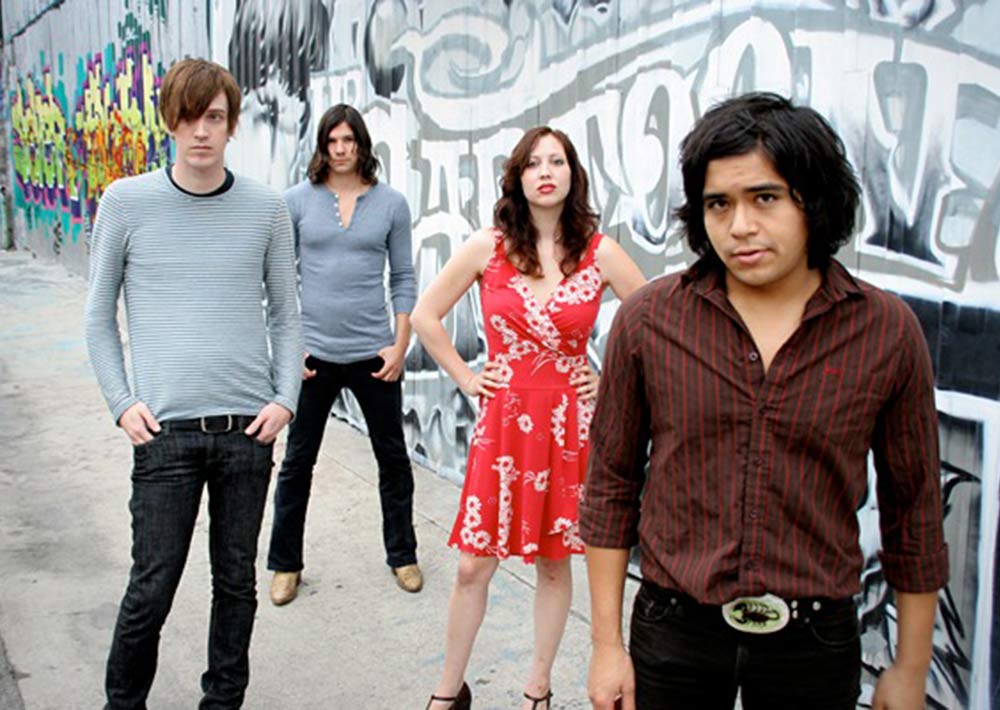
The Blood Arm’s Nathaniel Fregoso: “If something is designated a ‘verse’ or a ‘chorus,’ it can get forever stuck that way.” Photo: Amelia Tabullo
Singer Nathaniel Fregoso on a debut album that somehow captured one of the most dynamic live bands in the business
We recorded our debut album Bomb Romantics over one weekend in 2004 and self-released a thousand copies on CD. Most of the other bands on the scene in Los Angeles back then said they were waiting to ‘get signed’ before recording or releasing anything, and for better or worse, in typical Blood Arm fashion, we decided to simply plough ahead on our own and try to make things happen for ourselves.
We had built up a steady fanbase around Southern California and developed our chops as, in my opinion, one of the best live bands out there. We played live almost every week and rehearsed three or four nights a week outside of that. We figured that even if we didn’t know ‘how’ to record, our songs and our band were ready to give it a shot. It was a pretty big gamble, and it paid off. Bomb Romantics launched our career and gave us a wider worldwide audience, brought us overseas and got us our first proper record deal.
After we got signed, we officially released four more albums, but we never forgot the first songs we wrote and recorded together. We finally got the rights back to our back catalogue and decided that we wanted these songs to finally see the light of day, the way the rest of our music has. We had all of the tracks remastered and are now making them available on streaming services for the first time. Listening back, we love how much these songs hold up as a document of the time and our place in it, and we’re so happy to finally share the album with our fans. Here are some of my memories of the songs and how we wrote and recorded them:
We took our music very seriously but were always able to laugh together while making it
DO I HAVE YOUR ATTENTION?
I bought an old piano from a church when I was living in Koreatown, Los Angeles, and moved it myself to my small studio apartment. It was an upright piano with light wood paneling, and it was just slightly out of tune in the most honky-tonk of ways. It was great. I wrote the four-chord progression for Do I Have Your Attention? on that piano, and I was so excited about it. I think when I was writing it, I was trying to make it feel like a Bob Dylan kind of chord progression. But obviously, in the band context, it changed. And I knew, because it was repetitive, that it just sounded kind of popular. That lyric, “Do I have your attention?” came straight away. But I distinctly remember that we didn’t agree on the song – Dyan (Valdés, keyboards), didn’t like it at first. But after a while, we all warmed up to it.
Most of the arrangement came together in rehearsal. We had been writing so many different kinds of songs when we first started. None of us came from a songwriting background; nobody sat us down and taught us ‘this is part A, and this is part B, and this is a chorus and a bridge.’ So we were experimenting. And I think the result of all the experimentation was that when we kept it simple, it worked best. And I think this is a good example of that.
The whole song is only four chords, over and over. Zebastian (Carlisle, guitar) had to come up with different guitar voicings to keep it interesting. At the time, we were listening to Plastic Ono Band by John Lennon a lot, and there’s a song on that record called Remember that also just has four chords, but then is broken up with a halftime part. Dyan had the idea to ‘borrow’ that rhythmic shift for our song, and then when Zebastian came up with the guitar melody on top of the halftime part, we really felt the song come alive.
OPPORTUNITY KNOCK
I love John Cassavetes, and all the lyrics for Opportunity Knock were directly inspired by the film Husbands, which is about three guys who are mourning the death of a friend and go on a trip to London together. But it’s funny now, having spent significant time in Europe and London – “On the continent and on the island,” as I say in that song – so much of it was based on my own conjecture as a young man. People getting knighted by the Queen and so on. This was before we went to the UK as a band, so it’s nice to think of myself as a young person, excited about the world and excited about an image of London that doesn’t exist, which was based on this film, Husbands.
Musically, the song has a Latin element to it, which set us apart from our peers at the time, many of whom were directly referencing bands like Buzzcocks and a lot of post-punk from Britain. But being from LA and me having a Mexican and Salvadorian background, Dyan having a Cuban background, and Zachary (Amos, drummer) being Mexican, the Latin undertone was part of our DNA as a band. There are a few songs on this record that I would definitely say have a strong Latin musical heritage, which wasn’t really a part of indie rock in the scene at that time, or even now.
A magazine to keep. An archive to explore.
Get the latest edition, 40+ back issues, 3,200+ website articles and expert insights for songwriters
We also put a big drum solo in the middle of the song, which was completely illogical to do (and not something that was in style to do at the time). And even more illogically, we put Opportunity Knock as the second song on the record. But we didn’t know any better, and looking back, it’s just great that we were bold enough to do that.
IN FICTION
In Fiction stands the test of time, somehow, for me. It stands out from the rest of the songs and wasn’t the typical Blood Arm song for the time. I like that and think that’s one of the reasons why we chose it to be a single on this re-release of the album. Listening back to it now, I thought, well, I never went to therapy, but it feels like all I did was write about the personal issues in my love life. And a lot of our songs, maybe all of them, are direct responses to that: working out my issues, running away from them in real life, but dealing with them directly in a creative space. In fiction, as you might say. Sums up my songwriting career. Autofiction is the genre.
We almost never used any acoustic guitar at that point, and when we added that acoustic guitar strumming throughout the song to the recording it really changed for me. Most of this album is basically a faithful reproduction of how we played the songs live, which is great, but for the first time we had the opportunity to think about overdubs and things we could do in the studio to enhance the music. The idea for the acoustic guitar overdub came later, and I think it was a moment when we started to think of our potential as recording artists and not just a live band.
Of course, on later albums, we fully embraced the idea of using the studio as another instrument, adding overdubs with abandon! This is one of the first times we saw how a small addition to the basic tracks could really uplift the entire thing and transform the song into something new and different from the live experience.

Song-by-Song: ‘Catching Moments’ by Kim Cypher
We get the lowdown on an eclectic collection of songs that both captures mo... Read More+Song-by-Song: ‘Keeping It Together’ by Riva Taylor
The singer-songwriter on her EP shaped by travels through Latin America, ci... Read More+Song-by-Song: ‘Cold Blood EP’ by MIYA MIYA
A quartet who met at university, wrote songs for other artists and then for... Read More+

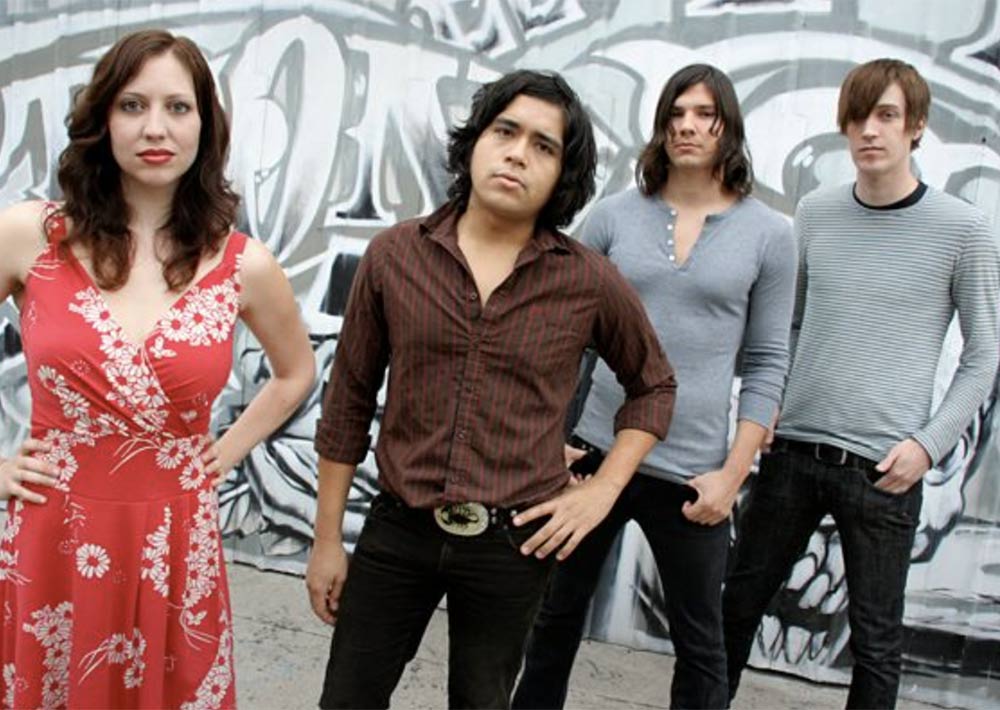
The Blood Arm’s Nathaniel Fregoso: “We were such a great live band, but how do you translate that onto the record?” Photo: Amelia Tabullo
CAN I UNWIND?
Can I Unwind? is a fun song. Zebastian actually had that riff in his back pocket since he was a teenager, I think. If I were going to name that song today, I’d call it I Can’t Wait Another Day, or something along those lines. But the title came from a funny story. We all went to see the Yeah Yeah Yeahs at the Troubadour in LA and Dyan somehow met Karen O and had backstage cocktails with her. We were waiting outside for her, and when she came out, slightly tipsy, we said, ‘Dyan, where were you?’ and she just sat on the ground and said, ‘I just met Karen O! Can’t a girl unwind? Can I unwind?’ We all thought it was so funny. At the time, we used to randomly name songs based on inside jokes, and this one stuck.
Musically, the song is essentially made up of variations on two very different parts. We took it as a challenge to try and make them work together, even though they were rhythmically so different. The song starts with a halftime introduction, then goes into an uptempo verse and chorus progression. It would have been easy to just have the introduction stand alone and never repeat, but we wanted to integrate it fully into the song. It comes back later as a bridge, and then we solved the problem of connecting it to the other part by putting Zebastian’s halftime riff on top of the uptempo part at the end, which felt like we were cracking some kind of code at the time. We always tried to keep songs interesting, for the audience and for us.
SAY YES
One of the songs that started to resonate with people, with fans, and obviously brought us some attention from the UK. What I’m always struck by is just what a challenge it was to convince the people who were recording us that we didn’t need a bassist. Nobody ever seemed to have a problem with the fact that we didn’t have a bassist when we played live, but anytime we went into the studio, it was a constant battle and a constant struggle. They would tell us, ‘You guys need a bassist,’ or they would try to re-record Dyan’s keyboard bass parts with bass guitar. And that wasn’t the sound we were going for.
But I think that’s what set us apart in many ways: it was a combination of our inexperience, but also our daring to just try something different that was not considered popular or the ‘right way’ of doing things. Interestingly, as soon as the Yeah Yeah Yeahs and the White Stripes got famous, we stopped getting so much shit for not having a bass player! But that keyboard hook of Say Yes,’ I don’t think that that would have been written if it had been on a bass guitar. It would have sounded completely different. I think this is a song that’s really representative of our lineup and in terms of the choices that we made.
I think that applies to the whole album as well. Most of the parts were written together in our rehearsal room. And if we had a bass player, they would just be different parts. There would be less space and we would combine the guitar, the keys and the bass in different ways. The keys probably would have had to have been more atmospheric, how they are often used in other bands, to provide dynamic lifts as opposed to driving melodic parts. And with our lineup, we only had to combine the guitar and keys and drums. That opened up the sonic space for us to try things like Say Yes out, with the main hook being a piano bassline.
Having the Latin rhythms really made The Blood Arm stand out from other bands in the scene
HEIR TO MISFORTUNE
What I love about Heir To Misfortune is that it is a nice kind of mid-tempo, heavy rock song with a good weight to it, very different from some of the more indie-upbeat songs we were writing. I remember when we were writing it, we discovered a sort of method where instead of calling a part a ‘verse’ and calling another part the ‘chorus’ and the ‘bridge’ and so on, we decided just to name the parts random things so we could just move them around.
If something is designated a ‘verse’ or a ‘chorus,’ it can get forever stuck that way with all the resulting value associations. Our method destroyed that hierarchy. We had that guitar part and called it ‘Piledriver,’ and would say, ‘Hey, let’s put Piledriver after Goose Egg,’ or whatever, and that kind of unlocked something for us. It gave us more flexibility with the songs, playing with the arrangement until it best served what we wanted the song to do.
One of the things that stands out to me about the guitar part is that it is totally dissonant with the keys and vocals in the verse, then resolves melodically in the chorus. We did that intentionally, even though it might be ‘technically wrong,’ in order to make the part sound abrasive and uncomfortable before the payoff that eases the tension. It reminds me of how David Bowie, who could sing technically perfectly, would intentionally sing slightly sharp when he wanted to convey moments of tension in certain songs. We weren’t sure it would work, but the first time we played it live in Downtown Los Angeles we had a great response from the crowd. After that, we leaned into the dissonance as an intentional creative decision, which really works here.
WANT X 3
I remember when we used to play Want X 3 live, I thought, ‘This is our hit song, this is the one the audience always reacts to, this is the one girls talk to me about after the gig.’ I was 100% convinced this was going to launch us into the stratosphere. Once we actually started interacting with music industry people, no one responded to this song. They all said, ‘This is not the hit.’ But I still love the song, and I think it accurately represents what we were trying to do at that time. I remember how much fun it was to play. Starting with the acapella part, really energetic, a ton of different parts interwoven together, this song was definitely written for the live performance. We got so excited to play it live every time.
And I think maybe that was, for us early on, our biggest challenge when we went into the studio. We were such a great live band, but how do you translate that onto the record? Later on, we started writing more for the studio, for better or worse. But absolutely, Bomb Romantics is an album written and honed on stage. Want X 3 is so energetic; there are a ton of different parts going on. Zachary’s saxophone on top of it brings out another layer; we didn’t even know he could play the saxophone until we went into the recording studio. He had his parts for this and Heir To Misfortune already figured out and just nailed them in one take. I love the sort of freeform jazz sax solo he threw in here; we were blown away when he played it, and it really does a lot to take the ‘live band’ version of the song to a ‘studio recording’ level, keeping the energy top-notch the whole time.
SHANNON
At the time, the song Shannon seemed like a little bit of an outlier, but somehow it sits well for me in the album. But it felt really different when we were recording it, different from everything else. I think we wanted this song to be dancey, and when we put in the dry kick drum hits it was definitely a reference to New Order. That was our bid to make this song a cool indie disco number.
Zachary had a crush on a girl named Shannon at the time, and he also loved Zebastian’s melodic riff in the bridge. So, we decided to call the bridge ‘Zach’s Delight’ and to name the song Shannon. Again, we gave the parts of our songs random names during the writing process so that it would be easier to move them around, which is definitely a technique we used here. And naming the song after our drummer’s crush was part of another Blood Arm tradition, which was to give songs names that were ultimately inside jokes between the four of us.
We were rehearsing at 10:30pm until late three nights a week and then also going to work in the morning, so having a good rapport with each other was a huge part of why we survived and had any of the success we did. We took our music very seriously but were always able to laugh together while making it, which I think kept us sane throughout those years and later years when things got a lot more intense with record labels, touring, and the stakes being a whole lot higher.
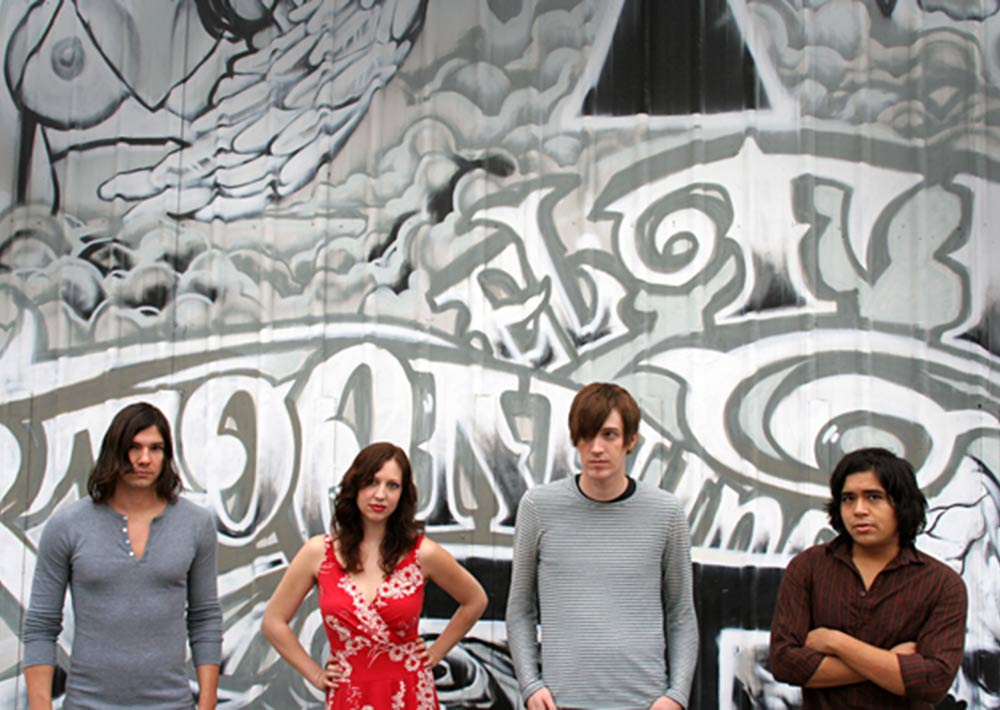
The Blood Arm’s Nathaniel Fregoso: “We gave the parts of our songs random names during the writing process so that it would be easier to move them around.” Photo: Amelia Tabullo
WORLD CLASS TRAVELER
The lyrics to World Class Traveler are really about me working at a post-production facility in Koreatown in LA, being bored and frustrated and wanting to be a musician, tour the world and have this lifestyle that seems so unattainable. It’s great that we actually attained it for a little while. But, I think it’s hard to write a song that’s sort of anti-capitalist and doesn’t sound kind of cringey. I wasn’t thinking about writing an anti-capitalist song, but that’s what it was.
It’s still true that you can listen to it now and be like, ‘Don’t work so hard.’ And this whole trap, just when you’re about to unravel, I’ll tell you the benefits. I think we all felt stuck in our jobs and frustrated. Our rebellion then was, let’s all go be loud in our practice space together. At the time, we were practicing three to four nights a week. It was like a clubhouse for us. And then we’d get up the next morning and go to work all over again, probably hungover, and be like ‘I don’t care, fire me.’ That’s the vibe I wanted to convey with the lyrics to this song.
Musically, I really like the hardness of Zebastian’s riff and Dyan’s bassline, with Zachary’s driving drums throughout, and then we have this sort of doo-wop style jangly high piano at the very end. Whenever Dyan played a part like that, we would call it ‘twinkle toes.’ In this song, the juxtaposition between the heaviness and rawness of the rest of the song with the playfulness of the ‘twinkle toes’ really gives it a lift. It reminds me of Serve The Servants by Nirvana, which is really just a doo-wop song played in a grunge style. That contrast really elevates the music and takes a song about a somewhat depressing subject – being stuck in a shitty job in a capitalist hellhole – and makes it fun and joyful in a subversive kind of way.
HOW WE WERE EATEN BY WILD ANIMALS
How We Were Eaten by Wild Animals, I remember that being a huge crowd favorite. Huge hit. It starts with an acapella chorus, kind of like a cheerleading chant. I got the lyric from my job; I was working as a film editor for DVD extras and a lot of my editing work at the time really fed into my lyrics. I can’t remember what movie it was for, but in the DVD extra there was a person who was being interviewed who said that all of his friends had been eaten by wild animals. It was so striking to me. I had to write a song about it.
Obviously, it struck a chord with the audiences too. After shows, people would chant the chorus over and over, as a sort of way of cheering for an encore. That was one of the first times that I realised that there were people who were actively coming to see us, they knew the song (which hadn’t been recorded yet) and would turn up and sing it to us while we were on stage.
The song had a very clear Latin music vibe, which I think also connected with a lot of the people that were coming to our shows in LA. There were no other bands with Latin lead singers, keyboardists and drummers at that time. Nobody with my skin colouring was from any type of band on the scene then. And I don’t think that you can overstate how important that was in LA. Oddly enough, this song became a sort of sleeper hit in Latin America, in Colombia. We have no idea how it made its way there, but we get random royalties from it and have been getting them for years. Maybe, once the song goes on streaming services and social media, we’ll figure it out!
O PASSIONATE ONE
Again, I think having the Latin rhythms really made The Blood Arm stand out from other bands in the scene. Especially during the middle eight part of this song, you can really hear the Latin influence. Zachary’s drum parts also really leaned into those rhythms, which maybe I didn’t realise at the time was pretty innovative. There weren’t many other bands taking Latin-style riffs into an indie rock space (or vice versa), and I think O Passionate One is an example of that working really well.
The song is a bit gloomier than the rest of the album, which makes it somewhat of a deep cut for me. But listening back, it definitely fits into the whole family of songs in a way that I didn’t necessarily realise then. We didn’t set out to intentionally bring Latin vibes into our songs as much as we did, but I suppose it seeped in because of our backgrounds – my dad was a famous Mexican songwriter (Teddy Fregoso) and Dyan is Cuban, Zachary is Mexican. A lot of our peers were deliberately looking to the UK (and back to the 1970s and 1980s) for inspiration, while we really prided ourselves on being a Los Angeles band. For us, that meant that the music we heard in our homes and on the streets had to echo in our music somehow.
UNTOWARD BEHAVIOR
Untoward Behavior is a great example of the dynamic tension of the band. Zebastian came up with that riff, and then instantly regretted it because he never wanted to be a riff-rock band. But, Dyan and I, who are huge Led Zeppelin fans, really responded to it. This was our great rocking out, mid-tempo, heavy Led Zeppelin-esque song. Zebastian, of course, doesn’t like those references and kept pushing them away, whereas Dyan and I totally love them. It is a great example of this thing that makes bands interesting: everyone’s taste being different, and the internal tension that creates. The end result is not a Led Zeppelin song, and it’s not what Zebastian intended either. It just becomes something in the middle, something new and exciting.
Zebastian presented the riff to us all in the rehearsal space, and I just felt like Dyan and I knew immediately what to do. The lyrics just came. There was no thought. Sometimes when it’s right, it’s just right. And we just knew. Arrangement came quick. Lyrics came quick. And it was like, done. It’s one of my favorite songs on the record and was one of the most fun to play live.
HEY GIRL!
For me, Hey Girl! really captures that time and the spirit. And listening to the recording, I feel like there’s only one way I was able to sing songs at that time, which was as if I were singing over a very loud rock band. I just didn’t know how to do it any other way. So, I’m singing, or rather yelling, that song, even though it’s an acoustic ballad. But I love that about it, too. I think it’s just indicative of where we were at as a band. And very authentic.
We recorded the song live together in one room in just two or three takes. You can hear me crumple up the lyric sheet and throw it away in the take we used; I guess as I realised it would be the final take. I’m glad you can hear that moment on the recording. Zebastian didn’t really like acoustic guitar at all; he only played electric. But he had his mum’s old guitar, a cheap guitar that she learned to play on. It was a shitty guitar, but it sounded great; it had a certain bite and personality. There’s no way it could sound cheesy in a Tears In Heaven sort of way.
Dyan was playing a slightly out-of-tune upright piano and Zachary was on the tambourine, and it was the only track that we recorded that way, completely live, acoustic and together in one room. The way we chose to record this song is not the way I would choose to record it now. We didn’t really have a lot of knowledge or expertise beforehand, and the decisions we made at that time are absolutely not decisions that I would make now. We made wrong decisions. We made wrong decisions and just did them because we didn’t know any better. That’s what makes it great and makes it impossible to recreate. It was a really special moment.
The last line of that song is, “I don’t believe it for a second, I don’t believe in our success.” I think back on those four kids in that room together then, singing about not believing in their success, they had no idea that they would release five albums and tour the world together with their music, and that Bomb Romantics would be the spark that started it all. It was a really pivotal moment that you can only appreciate in hindsight, and I look back on it with great fondness.
The Blood Arm’s debut album Bomb Romantics will be released digitally on 17 July. Find out more at thebloodarm.com
More Like This
Song-by-Song: ‘Three Kings’ by The Mining Co.
Michael Gallagher talks us through the five songs which make up his new fes... Read More+Song-by-Song: ‘Catching Moments’ by Kim Cypher
We get the lowdown on an eclectic collection of songs that both captures mo... Read More+Song-by-Song: ‘Keeping It Together’ by Riva Taylor
The singer-songwriter on her EP shaped by travels through Latin America, ci... Read More+Song-by-Song: ‘Cold Blood EP’ by MIYA MIYA
A quartet who met at university, wrote songs for other artists and then for... Read More+






More Like This