
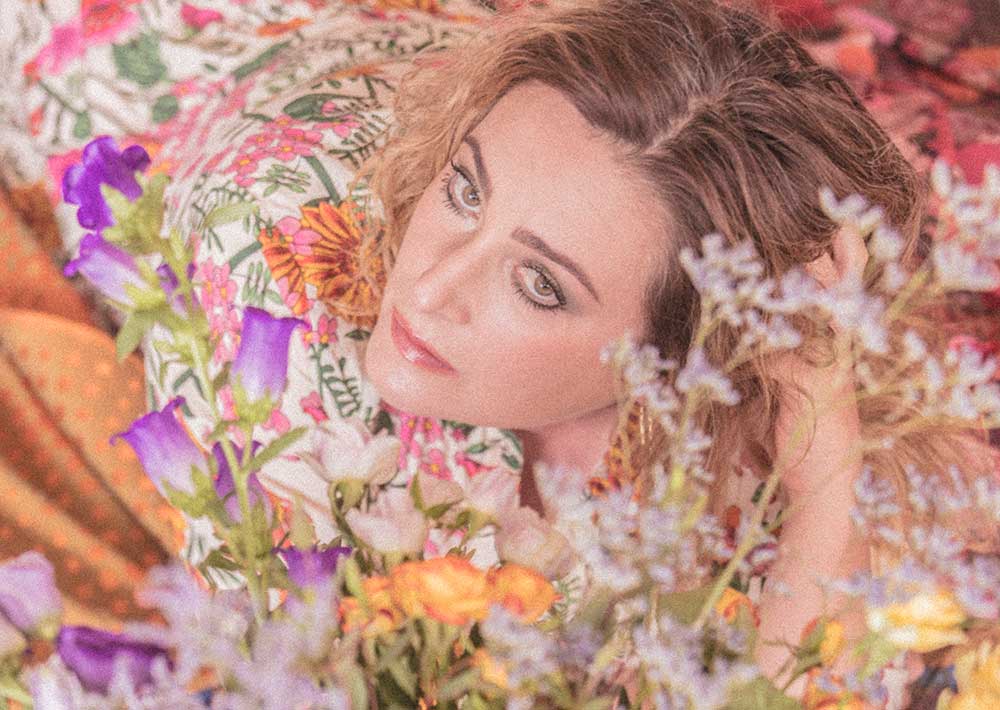
Rebecca Promitzer: “I wanted each song to have its own character but also be part of the story of that time.” Photo: Conor Masterson
After losing her beloved dog, these songs explore grief, childlessness, and passing time, finding beauty and hope beyond profound sadness
Austrian-born, Cornwall-based Rebecca Promitzer makes jazz-inflected, cinematic folk that balances intimate songwriting with lush, expansive arrangements. Her third album, Cusp, draws on the timelessness of 1970s singer-songwriters while exploring loss, longing and the possibility of hope….
Cusp properly began from the piercing pain of losing my beloved dog. She’d been with us since she was puppy and she would have turned 16 the year she passed away. Leading up to her dying, I’d been hoping, for many years, to have a baby, which sadly didn’t happen for me. Then there was Covid and the strangeness of that time and the death of two friends.
Amidst all of this was also the feeling of time passing, the loss of friendships, moving from London to live by the sea in Cornwall, memories from childhood and the past coming to the surface. So much uncertainty about the future. I wanted each song to have its own character but also be part of the story of that time. It was a time of letting myself be pulled into the depths of loss, grief, and vulnerability, and letting music soothe me and show me the way out and through.
Cusp is an album born from the threshold places of life: the moments when love and loss, endings and beginnings, sorrow and wonder exist side by side. Recorded between Nashville and the wild coastline of West Cornwall, the songs explore grief, longing, time, memory, desire, and the mysterious ways we are transformed by what we lose.
Moving between the deeply personal and the mythic, Cusp inhabits that liminal/heightened space where the ordinary world brushes against something larger and harder to name. At its heart, the album is about standing on the edge of change – between who we were and who we are becoming – and finding beauty, meaning, and even hope in the crossing.
I WANT TO LIE WITH YOU
I wrote this for my husband. I was feeling a sense of urgency – of life being finite. I was longing to lie in a summer meadow filled with wildflowers with him, with that kind of freedom and presence we enjoyed when we were students. Before the pressures of work and adult life took over.
I think for a lot of people – I know we had this – there’s a sense of, ‘When this happens,’ or, ‘When that money comes in,’ then we can rest and be happy. But our lives are now. There is no magical future when everything is perfect and you can finally say, ‘Now I can be happy.’ We have to seize the moment, drink in the beauty. It’s a kind of carpe diem song. It’s written in an Open D tuning. I use a lot of open tunings because I love the sound and because I work intuitively, guided by shapes and sounds, often before knowing what chord I’m playing.
EVERYTHING’S A LOSING
I was inspired by a Sharon Van Etten song (Staring At A Mountain) that plays over the titles at the end of a film called Never Rarely Sometimes Always. I liked the sparse feeling of the song, the intimacy of it and the directness. It’s unapologetically melancholy but also quite rebellious-feeling somehow.

A magazine to keep. An archive to explore.
Get the latest edition, 40+ back issues, 3,200+ website articles and expert insights for songwriters
My song was written at one of the lowest points in my life. I was going through a period where I felt I’d failed at everything. I felt deep uncertainty about my career, purpose in life, and I’d come through an unsuccessful fertility journey. What I like about the song is that it reminds me that no matter how far into despair I go, there is a part of me reaching for something hopeful.
While I was recording the vocals for the chorus, I kept seeing images of mountains in my mind’s eye and felt connected to the story of one of my great-uncles who walked all the way from Russia back to Austria from a prisoner-of-war camp. When his mother opened the door to him, she didn’t recognise him, and he collapsed in front of her.
SILENT WILD
I was reminiscing about the past; lost moments that were beautiful but never blossomed. This song is about how some people can awaken something forgotten within you, how we can feel a deep sense of recognition and connection almost instantly. Sometimes the timing is wrong, or the encounter is fleeting, but nevertheless we are changed forever.
It’s a bittersweet song of longing, loss, restraint and hope, with an acknowledgement of the gift of that one small but powerful moment. Alex [Wong], my producer, put felt over the keys of his piano so it would sound less perfect. I wanted this song to have a Tom Waits feel to it. I think pianist John Pahmer does a beautiful job on this track.
FARAWAY WINDOW
I have a Super 8 video of my mother that my father shot, of her in her twenties, walking along the seafront in Brighton where she had been a student. I have about 20 minutes of footage that my father shot of my mother, which is precious to me because my parents split up when I was six and couldn’t bear to be in the same room as one another after that. They had a very dramatic separation and divorce, so any photos (particularly the faded home movie I’ve got) fill me with a sad nostalgia of what seemed so romantic but wasn’t to be.
Faraway Window is a love letter to my mother. It’s about seeing her as she was when she was young: full of hope, sassiness, and also vulnerability, whilst knowing the story that unfolded with my father. In the song I sing, “You are the light in a faraway window and I am the night.” My mother was always the light I was looking for. As “the night”, I’m protective of her, yet there is also a distance that can’t be closed between us. Gideon Klein plays the beautiful Celtic-style violin part. My mother has always had a love of the violin.
THE SWEETNESS OF MISSING YOU
This song was written in my garden overlooking the sea in West Cornwall. It’s about a longing that is so familiar it feels like home. Here I am in a beautiful sunlit garden by the sea, but the one I love is not here. Yet, surrounded by so much beauty, even yearning becomes something sweet.
LEADING LADY
I was sitting in a hospital waiting room when I wrote the lyrics for this. I was seeing my endocrinologist and it was looking less and less likely that I was going to have a child. The idea of being his or her beloved mother, their Leading Lady, came to me. I saw myself as a West End actress knowing that her season is coming to an end.
There’s grief and loss in the song but also resignation and a sense of resilience, of moving on to explore other roles. This is one of three songs I wrote on the piano. It’s more pared down instrumentally than some of the other songs on the record. I wanted it to have a feeling of the Leading Lady standing alone in an empty theatre – she’s just there with the pianist. The members of the orchestra have all gone home.
I COULDN’T STOP THE SUN
Our dog, Lulu, who would have been sixteen later that year, died on the summer solstice. We were able to bring her home and she died as the huge burning orange sun was setting. It took such a long time and I knew that when the sun had set it would be the end of her life. It was so beautiful and so painful. The song I Couldn’t Stop The Sun came mostly out of that evening and a bigger feeling of time passing, of change, and the inevitability of death. It’s about a sense of powerlessness and maybe even the relief in surrendering to that. I kept changing the key of this song whilst writing it, I just couldn’t decide what felt right. In the end I tuned the guitar down a step.
FLOWERING FIELDS
I remember the day after Lulu died so clearly. We went for a walk at dusk and everything had changed. All my senses were like super senses. Everything seemed unreal, and, at the same time, more real and more beautiful than it had ever been. The colour of the sky was like liquid enamel, a pool with all the clouds reflected like a silent film, blossoms and roses that were bigger and more scented than I’ve ever experienced.
We were visited by a nightingale who made the most exquisite sounds. We felt like Lulu had sent her. I looked up nightingale symbolism and found that they can come to remind us of beauty and hope in moments of despair. I wrote Flowering Fields for Lulu to help deal with my grief over losing her, by reminding myself that she lives in everything beautiful around me.
SILVER DREAMER
Silver Dreamer is dedicated to Marc Bolan. I’d seen the documentary, AngelHeaded Hipster and loved Nick Cave’s interpretation of the song Cosmic Dancer. I love how he slowed the tempo and added the cello. A few days later, or maybe longer, I saw Marc Bolan in a dream. He was this universal figure of joy, playfulness, wisdom, and creativity. He was wearing a silver sequined jumpsuit and, in his transcendent state, seemed to have everything figured out. He transmuted human suffering into art while he was alive, and now, he’s in another realm where none of the weight of that suffering exists.
In the dream, I was part of that blissful, otherworldly state, a state of universal love, but then, on waking, I’m back in my body and this earthly life. In the song, I’m asking him for advice on how to be like him and still be here on this planet. I love Josh Kaler’s spooky lap steel guitar on this track. In the outro, I try to sing like a theremin, making a haunting, wispy sound. I’m imagining I’m a distant figure drifting into space or another realm altogether.
BLACK JAGUAR
This track is about taking back power as a woman. I was remembering times when I had been made to feel powerless, insignificant, and less-than by men and society; and times when I had felt used. This is a song about rising up, roaring, and not giving an F what people think. I’d been listening to The Coral’s Dreaming Of You and had written a song about how music can possess us, how it enters us and doesn’t leave. That song had a bit of a punk rock feel and I think Black Jaguar followed on from that.
BRUSH OF YOUR HAND
This song is a return to the intense longing for love I had as a young woman, and of sometimes, almost being willing to turn myself into nothing, be invisible and pleasing for the tiniest crumb of love. It reminds me a bit of the line in Jacques Brel’s song Ne Me Quitte Pas, “Let me be the shadow of your shadow.” The guitar is quite delicate, sparse, and repetitive on this, and there is a feeling of childhood songs in it.
THIS LULLABY
The first song I wrote for the album was This Lullaby. Ironically, it was meant to be a song to wake adults up; it was written out of their complacency and ignorance about the darkness and injustices in the world. It was meant to be reminiscent of the 70s take on the 30s you get in the film Cabaret. It’s a dark, cabaret-style song, and I play the ukulele on it!
Cusp by Rebecca Promitzer is out via Lost Garden on 21 October. Find out more at rebeccapromitzer.com

Song-by-Song: ‘Bloom’ by Hattie Whitehead
Songs about grief, greed, gender equality, mental health and more make up t... Read More+Song-by-Song: ‘Shadows’ by Talia Rae
Find out about an EP that draws from a love of romantic power ballads, Elon... Read More+Song-by-Song: ‘Littleuniverses’ by Littleuniverses
The songwriter from Montreal welcomes into the wor... Read More+



More Like This