
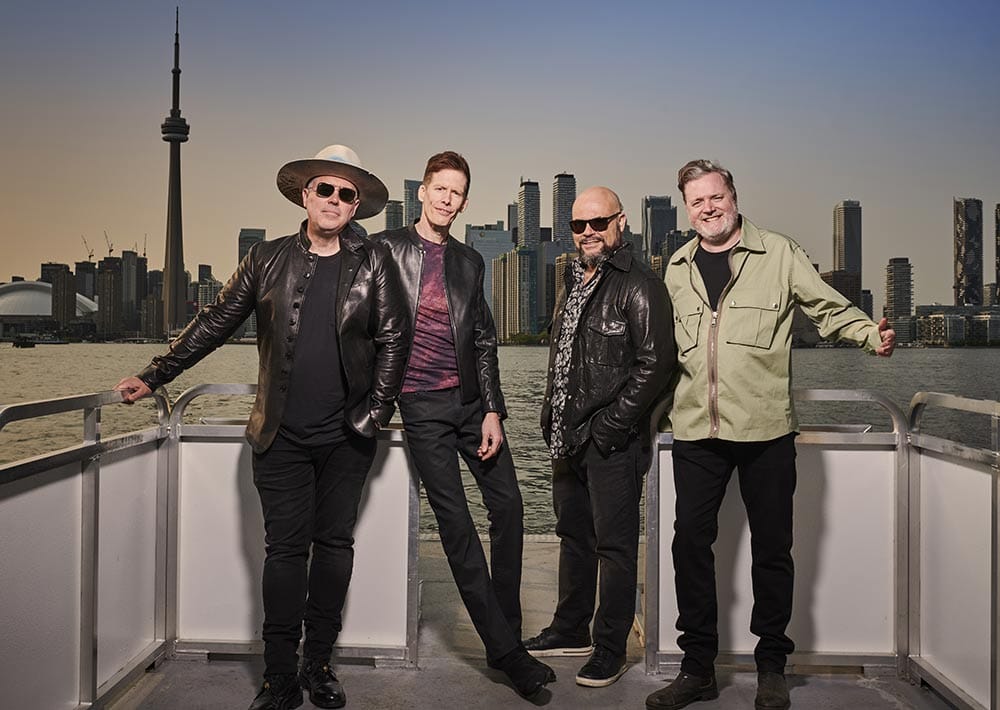
Barenaked Ladies: “It’s a bit of a trick, in and of itself, to have a chorus that doesn’t actually repeat.” Photo: Matt Barnes
An offbeat freestyle, unexpected label backing and studio reinvention combined to turn a quirky idea into a worldwide chart-topping phenomenon
Barenaked Ladies (BNL) are royalty of Canada’s alternative rock scene. Formed in the Toronto suburb of Scarborough, Ontario, their self-titled release in 1991 (the band’s third) became the first indie tape to achieve Platinum status, a springboard for a career that has seen them win multiple Juno Awards, sell over 15 million records and be inducted into the Canadian Music Hall of Fame. With a style that blends elements of rock, pop and hip hop, the group’s infectious hooks and clever lyrics remain a hallmark of their sound, as heard on their last album In Flight.
BNL’s international breakout came with their fourth full-length studio LP, Stunt. Released in 1998, the album is now four times Platinum in both Canada and the United States. Driving the album’s success was the rapid-fire and pop-culture-referencing single, One Week. With a rapped vocal that millions still try and, more often than not, fail to sing along to, it’s perhaps no surprise that lead singer Ed Robertson’s bandmates took a while to perfect the song live.
Those days are long behind, though, and with Barenaked Ladies heading out on a UK tour, Robertson reveals how the chart-topper came to be…
Article first published in Songwriting Magazine Spring 2024
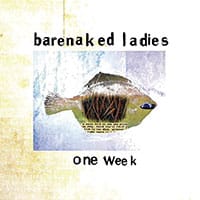
Released:15 September 1998
Artist:Barenaked Ladies
Label:Reprise
Songwriter: Ed Robertson
Producers: Barenaked Ladies, David Leonard, Susan Rogers
UK Chart Position: 5
US Chart Position: 1
“I had a sketch in mind of kind of the anatomy and the timeline of a protracted argument. And the psychology of a lengthy argument with a loved one. I had that sketched out and I pretty much had the three choruses, which, of course, sound the same, but are subtly different to progress the argument. It’s a bit of a trick, in and of itself, to have a chorus that doesn’t actually repeat. It’s a melodic hook, but the lyrics change and develop. I had that and I wanted to do a rappy sort of thing in the verses and I kept trying stuff, but it wasn’t working. I think in part because I was trying to expand on this argument notion and trying to fill in all the details of what happened between all of these moments. It was a bit heavy-handed and it was a bit forced.
“It was actually my writing partner at the time, Steven Page, who said, ‘Why don’t you just freestyle it like you freestyle every night? It’s better than this stuff you’re trying to write?’ So I thought, ‘Okay, well, I’ll give it a try.’ I set up a Hi8 camcorder I bought when my daughter was young to capture all those early moments on video – I have no idea where those tapes are now. I set it up on a tripod and I freestyled into it for about three minutes. And then I just transcribed and edited it. In fact, on the liner notes for Stunt, we included a bunch of the extra couplets that we thought were funny but didn’t make it into the song. So the song framework was there and then it was really just improvised.

Barenaked Ladies’ Ed Robertson: “Because it was such a weird song, I thought it might be a B-side or a bonus track… Number one!” Photo: David Abbott
“I was at home in Toronto preparing for that record [Stunt] and, the funny thing is, we already figured we had the record [finished]. I was just looking for bonus tracks and extra material when I wrote One Week. Because it was such a weird song, I thought it might be a B-side or a bonus track. In fact, Sue Drew, who was our A&R person at the label… She was great, we really, really liked her. She’s the one who hooked us up with [the producers] Susan Rogers and David Leonard and decided to work in Austin and Nashville. It really felt like we were working collaboratively with the label. They were like, ‘Okay, you guys know what you’re doing. We’re going to help you take it to the next level.’ It was a really good relationship, and we all really liked and trusted Sue. When she called and said, ‘We’re going to lead with One Week,’ I actually thought she was making fun of me! I thought she was like, ‘You’re stupid song shouldn’t even be on this fucking record!’ I really did laugh when she said, ‘No, I’m serious. We want that to be the lead-off single.’ I was flabbergasted… Number one! She did a very good job.
“I think everybody liked the spirit with which it was written, which was kind of fun and off the cuff. It was this oddball track, but also the demo was unlike anything else on the record because it was just like a hip hop loop, and some electric guitar power chords. So it was kind of cool, but it was like early Beastie Boys, really raw white boy hip hoppy. I thought it was going to be easy to pull off in the studio. But Susan, who engineered and produced the first half of the record – she worked with Prince for 10 or 15 years, so she was around so much amazing music for so long – sat down and goes, ‘Oh, that loop isn’t very cool.’ I remember being a little bit crushed because I thought it was so cool! It’s hard to hear that at first, but she was so right. It was just a loop with some bullshit samples or power chords that would’ve been super fucking derivative of Beastie Boys and shit we’ve grown up with. So instead, she pushed us into the Afro-Cuban [style] and all these melodic guitar lines that were really intricate and inter-woven. Kevin [Hearn] went crazy experimental on it. It was much more pop-rock driven – big, big pounds on the ones, which was kind of uncommon. It became something really interesting, unique, timely, not derivative, and not anything like the demo. So it really came to life from pre-production to recording and then it really sounded like a single. But I didn’t hear it like that.
A magazine to keep. An archive to explore.
Get the latest edition, 40+ back issues, 3,200+ website articles and expert insights for songwriters
“I think any success adds pressure to repeat it, even if that thing is so weird. That’s probably why the label gravitated towards Pinch Me as the single from the next record, because it had that rappy kind of chorus thing. That’s actually quite a dark, melancholy song, but it was still quite successful. So yeah, I think it was twofold, because the success unquestionably adds pressure, yet that success came from being really unconventional and quirky, and off the cuff. So in some ways, it bolstered our confidence to just be who we were, and stick to our guns in a way and be creative and spontaneous. So it was both. I won’t say it didn’t add pressure because it certainly did.”
The Barenaked Ladies’ album In Flight is out now. To find out more, head to barenakedladies.com
Read our 2016 interview with Barenaked Ladies’ Ed Robertson
More Like This

‘Fake Nudes’ by Barenaked Ladies (Album)
One of Canada’s most famous exports return with al... Read More+How we wrote ‘Stay Another Day’ by East 17’s Tony Mortimer
The songwriter and former East 17 member recalls t... Read More+How we wrote ‘Dreams’ by Gabrielle
Learn about one of the 90s’ biggest pop smashes and the highest chart... Read More+







More Like This