
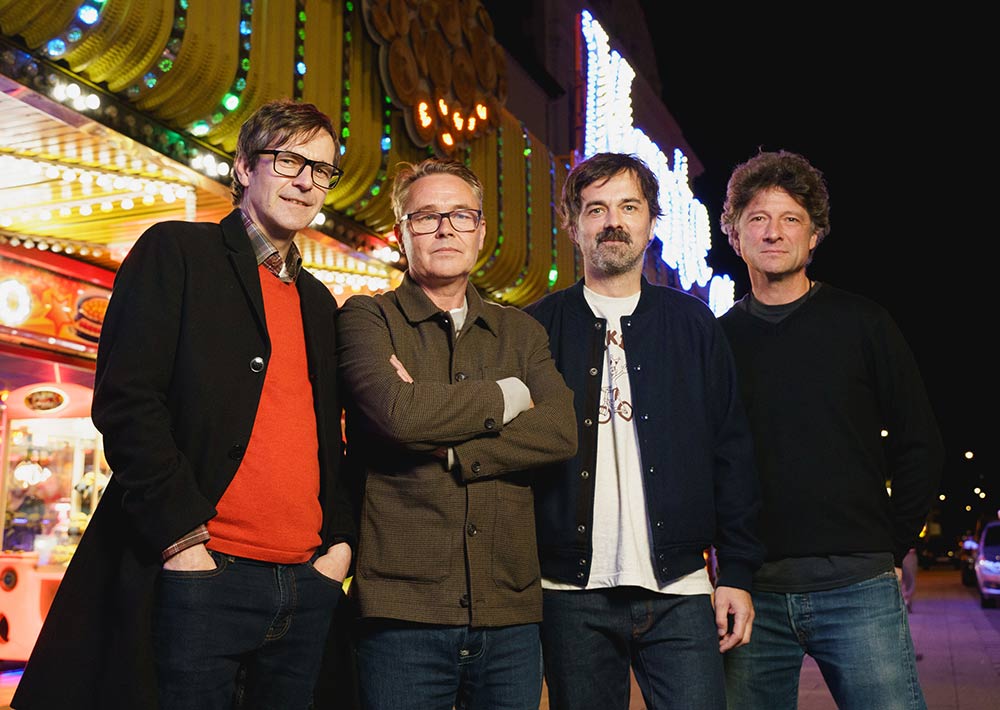
The Bluetones’ Mark Morriss: “You write certain songs as a younger man that you can’t write as an older man, and vice versa.”
Rather than rest on his Britpop laurels, the frontman and lyricist remains inspired to create new music with his band
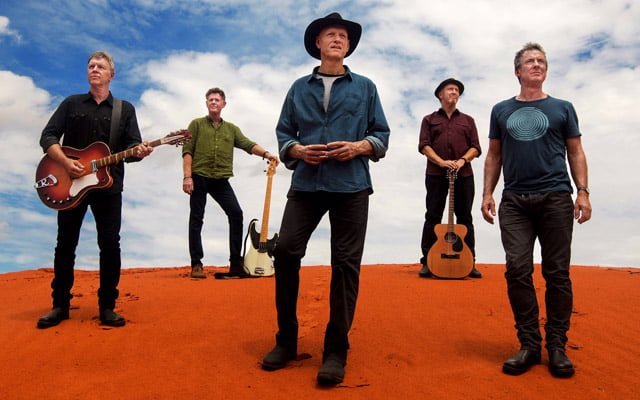
Last October, the London Weekend Television EP arrived, and with it another statement of intent from The Bluetones. Alongside the title track, it contains The Aristocrat and Play Shadow, and showcases the group’s continued songcraft. The third in a trilogy of EPs that will be collated and expanded upon later this year to become their first new studio album since 2010’s A New Athens, the quartet of Mark Morriss, Adam Devlin, Scott Morriss, and Eds Chesters remain clearly invested in writing and recording new material together, committed to the essential idea of being a band.
Make no bones about it, they could be riding the nostalgia gravy train. Born in the Britpop era, it is now 30 years since the release of their debut album, the chart-topping Expecting To Fly, which included classic singles such as Blue Tonic, Cut Some Rug and their biggest hit, Slight Return. A band with melodic assurance, a taut rhythm section, and lyrics that often belied the music’s jaunty veneer, other songs like Solomon Bites The Worm, If, and Keep The Home Fires Burning remain just as popular as when they first appeared. That they are keen to keep moving forward, seeking new sounds and audiences, is testament to their creative spirit.
Eager to learn more about the new material and how the group’s writing may have evolved, we caught up with frontman and lyricist Mark Morriss…
What differences are there in your process when writing songs for The Bluetones rather than writing for your solo projects?
“When I’m writing for the band, I don’t write the songs to such a complete state. I write them so they’ve got a melody, a beginning, a middle, and an end. That’s purely for the sake of presenting them to the band. Then, once everyone’s learned the beginning, middle, and end, we can mess around with it all. But it helps everyone get on the same page.
“That’s it really, that’s the main difference between writing for the band and myself. When it’s me doing the whole thing and colouring it all in, I continue the process. That said, when I do my own records, it’s never truly a solo project. I am in collaboration the whole time with my producer Gordon [Mills]. His input is vital.”
When you’re presenting to the band are you sat down with a guitar and singing to them?

A magazine to keep. An archive to explore.
Get the latest edition, 40+ back issues, 3,200+ website articles and expert insights for songwriters
“We rehearse and we play in a circle, so we’re all facing inwards. That’s it really. I play it to the others, call out the chords, and everyone joins in. We groove and we jam it out for a while, and then we have a break and come back slightly different. That’s the process with the band. Everyone has to find themselves in it. It can take a couple of days for Scott or Eds to click into something and go, ‘Okay. I can make this mine. I can make this me.’ That’s when things accelerate, when everyone finds themselves within the tune. Like I say, with the band, I write just the chords and a loose groove that always changes.”
Will you talk about the inspiration or meaning behind your lyrics or is that not really part of the group writing?
“It’s not part of the group writing. I keep it to myself and I wait ‘til they come and ask me. And sometimes that’s years. I was thinking about this the other day, because I could be sneaking in all kinds of political bullshit and the guys would be completely oblivious, just concentrating on their own little bits. There’s an element of trust, and I think they quite like the mystery as well.”
Are there elements that you’d identify as signature sounds of The Bluetones?
“I think we’ve got a couple of things that we do. I like to have the juxtaposition of something that has a melodic mood that’s one direction and then, when you scrape a little bit below the surface, you find out the song is about something completely different.
“The thing with us, it’s difficult to put a finger on, but it’s something as basic as the chemistry of us four playing. I can’t put my finger on it either, but it’s there whenever we get together and whenever we start working on new things. I don’t know what it is, and I think if one was to overanalyse it too much, you fear that you’re going to give the game away to yourself.”

How we wrote ‘Chasing Rainbows’ by Shed Seven’s Rick Witter
The singer with York’s indie guitar heroes l... Read More+Interview: Tim Burgess
We got to know the Salford-born singer-songwriter who you’ll recognis... Read More+Interview: Sophie Ellis-Bextor
The singer and songwriter who arrived in the 90s with Theaudience talks abo... Read More+



The Bluetones’ Mark Morriss: “Once I’ve got the opening line, I’m away.”
Is creating new music together still a big driving force behind what you do?
“It has been in the last couple of years. We wanted to get started sooner on this project. Then, of course, we got hit by all the lockdowns and whatnot, and that threw us right back. We lost a lot of momentum, about four years. Then it was just getting the band back to the same ticking-over place that we were before, once all the things like touring had ended. Once we were re-established with that, we were in a position where we could fund our own record label…
“At the same time as this happening, we had the good fortune of finding a new place to rehearse and record, which is closer to all of us. More importantly, it’s very close to Gordon Mills, our producer and other collaborator. We could be rehearsing and he could be there every day, and he could be recording us and helping us. When everyone’s got their head down and concentrating on their bits, he’s a good outside voice to help us shape things. Those elements were really what brought us back into the position where we could record again.”
Was it a good feeling to be back in that groove of recording?
“It’s been brilliant. It’s all the cliches: it’s been a real lease of life and everyone’s feeling motivated again in a different way. Having new material to get excited about and concentrate on has made playing the old songs easier, in a weird way.
“We can slip into those old clothes anytime, but this is something that we have to inhabit in a different way. It’s not us going through the motions, but you take it for granted that you can play these songs better than anyone else. That sounds really crude and basic, but I think you overlook that fact sometimes in a band.
“We were talking about this recently, because it’s 30 years since the release of our first album and these thoughts are starting to surface amongst us. It does feel very surreal that it’s been 30 years. We’ve come to a place where we acknowledge what our audience wants from us, as well as being able to push ourselves forward gently in a new way that’s not going to make people not want to buy tickets anymore. It’s coaxing them in gently. These new songs, in two- or three-years’ time, they’ll be old songs to the audience, and they’ll be calling for them rather than scratching their chins.”
Does that come into your head when you’re writing? I’m sure you’re not writing a song thinking, ‘This needs to be something the audience are going to get into.’ Do you want to cocoon yourself from all that at the point of creativity?
“Absolutely right. We don’t think about our catalogue. The only time our catalogue comes up when we’re creating is if something sounds like something we’ve done before and we go, ‘We don’t need to do that. That sounds like that song. We should probably think of a different vibe for that part.’”
Is the initial part of collecting ideas and getting the song ready to present to the others a compulsion or something you have to set time aside for?
“In the past, it’s been something that I would stew over for ages and spend way too much time worrying about – lyric writing – and making it more of a pressure on myself. These days, I keep a lot of notes, I write a lot of verses down. Things pop into my head; I’ve got a little notebook I carry everywhere. It’s not that I refer to it a lot, but it’s in your head. It becomes solidified, once you’ve written it down.
“When you’re a songwriter, there’s always something at the back of your mind which is trying to finish an idea, or even start an idea. I’ve found in the last year, working back again with the band, that all I need is a little bit of “boom” – that spark. That spark comes from the room. There’s been occasions with all the new stuff where I’ve had ideas that I’ve not been able to tie together. Then, you get that spark, that thing the song dictates, that this piece of music is dictating, and I’ve gone home, written the lyrics in one night and come back the next day with a finished song. That’s happened quite a lot recently, and it’s in all of us in the band, everyone’s doing that. Everyone’s going home and thinking about it.
“In the past, when we were in the writing and recording process, we’d have endless time in the studio and endless time to rehearse. Now, what with our lives being different, we have set times when we’ve got to focus, and it really has sharpened us all up. We can do more time if we want, but it costs a bloody fortune. It focuses everybody, realising that the pressure’s on.”

The Bluetones’ Mark Morriss: “Having new material to get excited about and concentrate on has made playing the old songs easier.”
Does that imply that you used to be a band that liked to tinker in the studio as well as in the rehearsal room?
“It was more the case of… we were often sent away to these really lovely studios and part of your brain is going, ‘Oh, I’m on holiday. Look, there’s a pool, there’s a flood-lit tennis court, there’s a pool table, someone’s making us lunch and dinner…’ That’s not really what you’re there for, but, as younger men, we loved all that. We’re less distracted by those things now.”
It feels like that world isn’t so much there for most bands and artists now…
“Well, sadly not. But there’s still one or two. Where we are, it’s not a luxury studio, however, it is a lovely old house that we’re in. It belongs to this really generous couple who let us keep all our equipment there, rehearse and record there whenever we want.
“That environment has been very inspiring. It’s not a strip-lit studio with no windows, it’s a working house. There’s a family in there. When we have a break and we have a cup of tea and go and sit in the garden for a minute, we’re talking to the family that lives there. You’re not just talking to a bunch of musicians who might be hanging around, it’s different. It really has motivated us. The environment is really inspiring… having natural light coming through the windows whilst you’re playing, that sort of thing.”
With regards to the initial stage, are there times of day that are best for writing or places you find most conducive?
“Yeah, I like to be at home, at this table, actually. I’m in Kent these days. I’ve been here for a few years now, Tunbridge Wells. It’s not as posh as it sounds. It’s usually, of late, the evening of a really good day’s rehearsal. I come in, make myself something quick to eat and then sit at this table. I’m right in front of a big window here, so I sit here and smoke. I know I’m indoors and it’s disgusting, but that’s why I have the big window open.
“Of late, that’s been it for me. It’s been coming home and keeping the momentum going. You have ideas, but it is a sort of mental constipation. Something’s building up, something’s coming. This verse, this complete tale… and then you need a trigger to get it all out. It’s sometimes melodic, the thing that goes, ‘Ah, that’s it. That’s the opening line.’ Once I’ve got the opening line, I’m away.”
Where does the ability to construct melodies come from?
“I think it’s that thing, you know, when you hear filmmakers talking about, ‘Oh, you want to be a filmmaker, well, go and make a film.’ The first one won’t be great, but the thirteenth one might be okay. It’s the same. It was just trying it, from being a kid and going, ‘I want to do this.’ I used to write poems at school, but it’s a case of, ‘No, I want to be a songwriter,’ and making that decision of, ‘I want to write songs.’
“In my teens, I was studying theatre and that sort of thing. I was going on stage, and you’re always interpreting other people’s words and other people’s stories. Once I got seriously into music, I liked the idea of being a creator, rather than just reciting.
“So, I started to write some songs like, ‘Oh, they’re okay.’ and they just gradually evolved. They get better, the more of your time you’re giving up to thinking about it. Your brain changes from listening to other people’s songs, and the way you listen to them changes. You listen in a more analytical way, and you can’t turn it off anymore. You’re always learning, it’s like, ‘What was that chord progression?’ And you look at it and you figure it out, ‘Oh it’s a B minor to a G7, I didn’t think that would go together but it sounds fantastic if you do it that way.’ Two chords you’d never slam together, you hear them on a different instrument, it’s like, ‘Right, okay, that actually works.’”
If you’re on this constant line of improvement, can it be frustrating that the number of people who are listening and buying your stuff might not be as big at the point that you’re at your peak?
“Kind of. Of course, there’s an element of that that you carry around with you. But if you think about that sort of thing too much, it will paralyse you. I think you have to acknowledge as well, that you write certain songs as a younger man that you can’t write as an older man, and vice versa, and the audience came to you when we were all younger, for the most part.
“It’s nice, the fact that we have got teenage children and grown-up kids now, to sort of relate this to… With the new stuff, I’m aiming for those young minds again. I’m not necessarily just thinking of our audience… I do think of what my 17-year-old would like. He’s got pretty good taste, and I don’t take the credit for that. He’s gone out and found things for himself. I like the idea of him putting this on by choice, playing it to his friends and saying, ‘My dad’s band did this,’ and they’re going, ‘Oh, that’s good.’ That idea motivates me.”

The Bluetones’ Mark Morriss: “It becomes solidified, once you’ve written it down.”
With all the Britpop anniversaries and reunions, and that extra exposure, have you noticed that the younger generation are getting into it?
“Yeah, I have, and it’s reflected in the shows. There are younger faces appearing at the shows, and it’s good to see. I’m coming to terms with this ‘Britpop’ word. For me, it means ‘from a time’ rather than ‘from a scene’. That’s how I think of it. And there’s no denying we’re from a time.
“My son, to be honest with you, he’s only really started getting passionately into music in the last couple of years. He was very into new hip hop about three or four years ago, and I was encouraging him in that regard, took him to a couple of gigs, but he’s suddenly exploded into a huge fan of 70s rock. A lot American bands, as well, from nowadays, and stuff I’d never heard before, like Mountain. I’ve got him into Steely Dan. He said I’ve played stuff in the past that he’s really liked, and it made him check them out, but I’ve never thrust anything on him… except for Steely Dan. I was like, ‘You’ve got to check out The Dan, man.’”
Were you close to the age he is now when you formed the band?
“I was probably about a year older than George is, about his age actually. It was 1989 and I formed a band as a direct result of being at a Stone Roses gig. I was there with my friend, and his friend was in a band that was looking for another member. I’d never met him before. I went to the Stone Roses gig, and on the way out, I was like, ‘Can I join your band? I’m gonna be in a band now, let’s do this.’ I’d been in school bands, but they don’t really count.”
If you asked 18-year-old Mark whether he thought people would still be discovering his music in 30 years’ time, would he have been able to comprehend that?
“No, it wouldn’t have been something I’d contemplate. I don’t think it was something you considered doing for the rest of your life at that point. I thought I’d make my millions and get out. I haven’t, not yet.”
I guess the true question I’m asking is, how does it feel to write songs that stand the test of time and are still played on the radio every day and are being discovered by new audiences?
“That does mean something to me because I have something to reference then, I’ve got something I can think of. There are bands who I would go and see who put albums out 30 years ago. I went to see Love last summer when they toured and they still have Johnny Echols in the band, so I can relate to that. I’m there for the songs, I’m there for the vibe, and I want to be with those people.”
You must feel proud of that accomplishment, that you guys have written songs that people still want to hear and see performed 30 years later?
“Quietly proud. You don’t think about it too much, but it’s a positive feeling. I feel lucky more than anything, to have had that consideration.”
What’s coming next?
“An album in 2026. We’ve already started working on that. I would normally be in the studio today, but we decided to let ourselves have a couple of days rest. We’re back in the studio next Tuesday, so we’re doing it in between shows and on the tour; sound checks and whatnot. The three EPS was always the most practical way for us to do it, in terms of where we live. Scott lives in Japan, so he has to come over for chunks. We don’t do anything long distance. Well, we share ideas long distance, but we don’t do anything recording-wise.
“Doing it this way means we’ve been able to introduce the songs gradually to the audience. They’re coming out three at a time, and it’s been a way for us to make money from the EPs to go into the fund for rehearsing, recording, manufacturing… the whole thing. It’s been a nice way to work, a nice pace, and I think doing it this way keeps the quality control high. When you’re concentrating on three or four songs, rather than eleven or twelve, there’s no sense of anything being rushed.
“I feel upbeat about the album coming out as a whole, with a couple of extra numbers. It’s gonna be all three EPs with a couple of extra numbers, but it will feel like one thing. If people give it some consideration, they’ll like it. It doesn’t sound like a band going through the motions. I don’t think it sounds like a band in their mid-50s, it sounds fresh and energised. I really am pleased with the way it’s going.”
The Bluetones’ London Weekend Television EP is out now with an album to follow later this year. For news and tour tickets head to bluetones.band and you can also read Mark’s account of how the band wrote the Britpop anthem Slight Return in the latest issue of Songwriting Magazine
More Like This
Discover: Britpop
We choose to revel in the big-chorused glory of mid-90s British pop music, ... Read More+How we wrote ‘Chasing Rainbows’ by Shed Seven’s Rick Witter
The singer with York’s indie guitar heroes l... Read More+Interview: Tim Burgess
We got to know the Salford-born singer-songwriter who you’ll recognis... Read More+Interview: Sophie Ellis-Bextor
The singer and songwriter who arrived in the 90s with Theaudience talks abo... Read More+









More Like This