

Laurence Jones: “When I got ill with Crohn’s disease, I wrote songs about how to get me through the bad times.” Photo: Blackham Images
From classical discipline to blues confession, songwriting becomes survival, resilience and freedom while navigating Crohn’s disease, independence and creative truth
Even as a teenager, Laurence Jones had already begun to attract the kind of attention most guitarists spend a lifetime chasing. A Liverpool-born blues prodigy he’s topped the UK Blues charts, been voted among the world’s leading blues-rock guitarists, and shared stages with everyone from Ringo Starr and Van Morrison to the late Jeff Beck and Johnny Winter. Buddy Guy once described him as “a young Eric Clapton” – praise that neatly captures both his technical ability and his deep-rooted feel for the blues tradition.
Yet, for all the accolades, chart positions and guitar-hero comparisons, Laurence’s relationship with songwriting has always been rooted somewhere quieter and more personal. Long before the big stages, record deals and industry expectations, it began with an eight-year-old discovering a guitar – absorbing the discipline of classical study before slowly breaking free into the looseness of the blues.
With On My Own, his first fully solo acoustic album, Laurence finds himself coming full circle. Written during a prolonged Crohn’s disease flare-up, the LP strips everything back to voice, guitar and emotion, capturing songs that are less about career momentum and more about endurance. Cut off from touring and forced into stillness, songwriting became both refuge and release – a way to process pain, isolation and resilience without dilution or compromise.
In our conversation, Laurence speaks candidly about how illness reshaped his priorities, why creative independence matters more now than ever, and how changing tunings, guitars and approaches helped him reconnect with instinct, curiosity, and the deeper purpose behind writing songs.
The more real you are, the more people connect with you
Take us back to when you first started playing the guitar to write songs, rather than learning covers.
“Well, it’s very different for me – very structured. I was born near Liverpool, in St Helens, and around there in the 90s, there was the boom of Britpop. Then, when I was eight years old, my parents moved down to Warwickshire, and that was the other extreme – they were more into classical music. But at the age of eight, I picked up a guitar. My dad had one lying around the house, and he could play House Of The Rising Sun, so he taught me how to play that before I even had a guitar lesson. My dad was all right, but he’s a builder – he’s got big, chunky arthritis fingers – so he wasn’t very inspiring on the guitar! But not having any brothers or sisters, I was determined to be better than my dad.
“Then I started playing the classical guitar at school, got into lessons, and I did all my grades in that. It’s great for structure, but when I was 13-14 years old, I wanted to write a song. By that point, I felt it in me that I had the tools – from being trained in the classical guitar – to teach myself the electric guitar. Having that freedom to improvise and make up whatever song I wanted to felt incredible. That’s what led me to the blues, as that was all about improvisation. So I got into Eric Clapton, and from Eric I got into Robert Johnson.
“I remember probably writing my first song around 14 or 15, and setting up my own band called Free Beer. So yeah, I used to tour all the pubs and, as you said, doing all the covers. Then I seriously started songwriting throughout, and it just sort of carried on through, like 14, 15, 16 years old, and then I got my first record deal when I was 17.”
A magazine to keep. An archive to explore.
Get the latest edition, 40+ back issues, 3,200+ website articles and expert insights for songwriters

Zucchero: My Songwriting Hero, Bono
The ‘father of Italian blues’ waxes lyrical about ... Read More+How I wrote ‘I’m Just A Singer (In A Rock And Roll Band)’ by The Moody Blues’ John Lodge
The bassist and vocalist from Birmingham’s legenda... Read More+Interview: P.P. Arnold
Five decades after becoming a 60s icon, the first lady of soul talks about ... Read More+



Laurence Jones: “A lot of my songs are in an open D tuning… It was almost like learning the guitar again.” Photo: Blackham Images
With your first foray into songwriting, did you naturally look to do that as a solo pursuit? Has it always been a very personal endeavour, or did you try writing with the band?
“I always did it from a personal point of view, and then I sort of put the band together. When I was writing the songs, I’d come from a classical background, so I was writing them with a finger-picking style, as it was on the classical guitar, but then translating that to the electric was very different – it was freeing to me, almost. You know, I love bands like Cream and Jimi Hendrix, so I could just turn it up and fire away. But with my new album, it feels like I’ve come back full circle to where it all began. When I got ill with Crohn’s disease, I wrote songs about how to get me through the bad times. I got diagnosed with Crohn’s when I was 18 years old, but I’d suffered silently for several years before they knew what it was. So I always had that pain and suffering inside me, to relate to, with a mixture of a bit of heartbreak when you’re a kid.”
Pain and suffering can be a useful ingredient for a songwriter. Although it’s usually about love and relationships, emotional pain rather than anything physical.
“I think it comes from the blues aspect. I just found myself leaning towards that naturally, even though I was writing a bit pop-y at times and rock-y, because that’s the Northern side of me. I guess the blues and the finger-picking style all helped with that classical aspect. So it was like almost being able to write freely around that blues formula, but also trying to be a contemporary blues artist, not just traditional. But on this new album, I found myself coming back to the traditional even more. As I’ve got older, the more mature I’ve got, the more I want to dive into the traditional blues, which is exciting as well.”

So tell us a bit about your approach when you sit down to write a song, and whether it has changed over the years. Is it a case of having a bit of a noodle and jamming to see what comes through? Or do you have a very clear idea of what you want to write about?
“That’s a great question. I mean, nine times out of ten, I’d say it comes from picking up the guitar and just noodling, and something coming out of it. In a magical way, that’s what I’ve always liked about music… But then I’ll often have, say, a title, and that’ll be the theme. I can almost see the song, lyrically. Like on my new album, On My Own…”
Watching the video of On My Own, we were intrigued by the box-shaped guitar you’re playing.
“It’s very interesting that guitar. It was specifically made for me by a company called Dirtbox Guitars in Cornwall, by a guy called Jeff. He’d got an old antique wardrobe gifted to him, so all the components, like the knobs, are from the wardrobe. And he had bits of planks of wood donated to him as well. It’s a proper bluesy swampy guitar, you know? I saw Seasick Steve at Rough Trade, I got invited to a really intimate little record store signing, and he used all these guitars that he’d made himself – really cool, swampy guitars. I got speaking to him afterwards, and he just inspired me, so I was like, ‘I’m gonna get one of them and see if a tune comes out of me.’ What’s really interesting is different guitars will make you play differently and inspire you to write a certain way, which I’ve always loved about songwriting.”
I was wondering whether you wrote the song on that guitar?
“I actually wrote all the songs on a normal acoustic guitar. The thing that’s really interesting, which I’ve never done before, is that a lot of my songs – over half of them – are in an open D tuning. It’s really nice. It was almost like learning the guitar again, for six months…. But at first, what was really nice is that I was almost picking the guitar up and just playing freehand, not knowing what the notes were, not knowing the right position, or anything like that. So that was actually really refreshing for me. That inspired me a lot for the album: the unknown.”
Yes, we hear that a lot – changing tuning or trying a different instrument to freshen things up. Was that a deliberate decision because you found yourself going into the same patterns?
“Yeah. I mean, I’ve been playing the guitar for 17 or 18 years in standard tune and drop D. So I thought, if I’m going to go ‘on my own’, literally, I need it to sound bigger and warmer and fatter. And a lot of these old school blues guys were playing open tuning as well, to give them a bigger sound and a warmer sound. For example, you can put your first finger over any bar, and it’s a chord. But then, with that, it’s got its disadvantages of not being able to solo in the standard, generic pentatonic scale that everyone leans towards. So yes, it’s sort of what I wanted to get away from.”
Do you use any other instruments?
“Yeah, I’ve got a baritone guitar, which is like a bass. Sometimes I pick it up if I want to do a heavier riff. Or I’d play a ballad on the piano, but I sold my piano about five years ago now. With the guitar I feel most comfortable, to be honest, because I was finding that when I was writing them on the piano, [the songs] were more poppy than what I’d want to write. And in terms of the songwriting, the guitar just feels like it makes sense to me – I’m just very comfortable with it.”
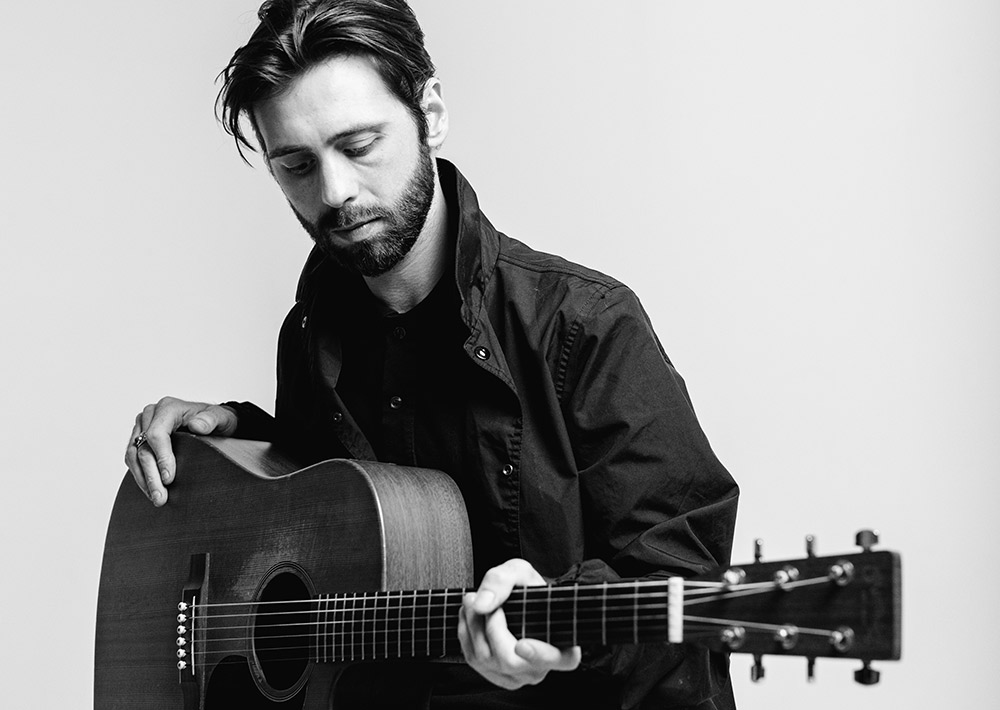
Laurence Jones: “I literally didn’t care about the money. I just wanted to be happy.” Photo: Blackham Images
That’s interesting. Do you have a ‘songwriting guitar’ that helps you get into that mode?
“No, no, it’s a feeling for me… I’m not as attached to guitars as some people can be. For me, it’s more about being attached to the genre and the sound and the feeling, the way the chords make you feel.”
“And that’s why I wanted to be endorsed by PRS guitars, as it’s like getting in a brand new car. They’re so nice, so smooth, and they’ve got great resonance.”
PRS aren’t known for the acoustics, are they?
“They’ve been making them for years, but yeah, they’re mainly known for their electrics. I think that the acoustics are very underrated.”
What feeds your creativity and inspires you?
“Anything hard, anything that makes you feel a certain way. For example, the music industry. I’ve been signed for many years, and this is the first release on my own record label, Ron Records, named in loving memory of my granddad – he saw me over the years, come and go with various labels, from great independents to even Sony in America. Somewhere along the way, the music can get watered down because of suits and business people in the office who aren’t musicians, but who have an opinion on it, because there’s a lot of money invested in it, behind the scenes – that’s the truth. So on this record, I literally didn’t care about the money. I just wanted to be happy. I felt like getting really ill with my Crohn’s; at times, it was very scary. I went down to seven stone, and I was passing blood a lot, and [thought] I wasn’t going to make it. So I needed the songs to pick me up because I couldn’t leave the house. For at least three to six months, I had to cancel work, and my partner was looking after me. So it was my sort of happiness as well, the only thing I could do and needed to.
I thought, you know, this industry is quite cruel… It’s a cutthroat industry. So I wanted to write from my experience, because I’ve been in the industry a long time, and my fans have always supported grassroots music and always supported independent artists. And when you’re ill, you do realise who’s there for you and what really matters. So I think that fighting on and keeping positive kept me going, really. Even when you’re sick, you want to live, you want to get out, and you’ve got a dream.”
What you’re talking about is very personal to you, but I can imagine that a lot of people would find that resonates in their own way.
“I’ve always tried to speak out and be an ambassador for Crohn’s and Colitis, but I’d be completely honest with you… I’ve had managers and agents and people in the past say, ‘Go on, push that, because it’s a talking point.’ And I’m like, ‘No, I don’t want to push it too much if it’s not real.’ So I’m very much about talking freely and doing it for the music, and that’s what felt natural to me… It was almost like it was all I had left.”
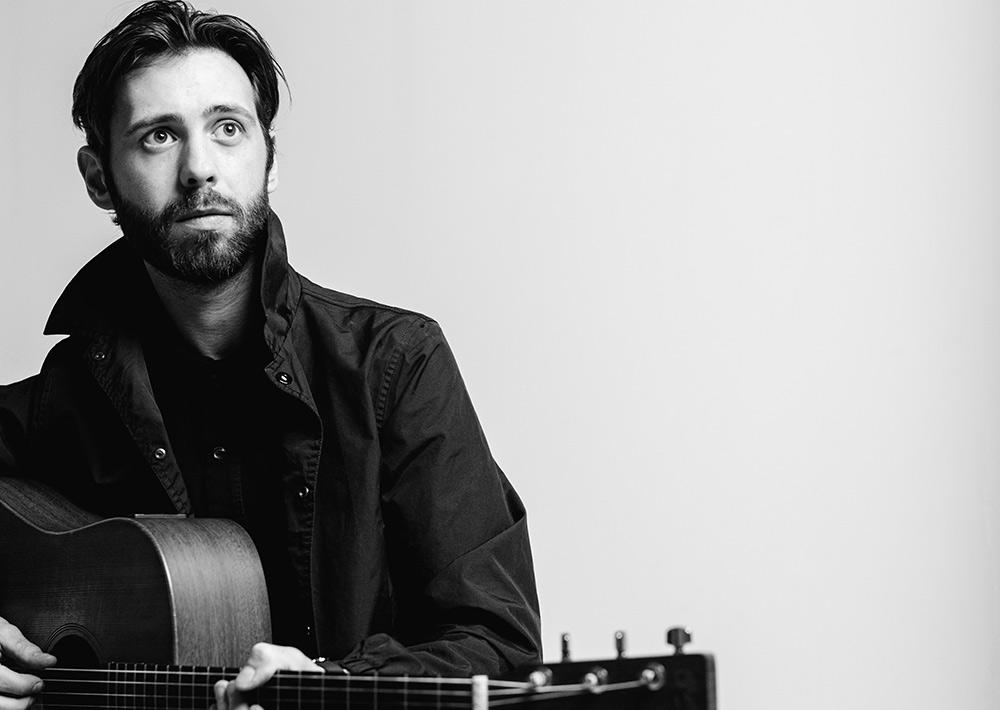
Laurence Jones: “The more real you are, the more people connect with you.” Photo: Blackham Images
And it’s getting that balance right, isn’t it? And it’s really important, because it’s probably fair to say that a lot of people don’t really understand Crohn’s.
“I’ve got to speak about it, raise awareness. But at the same time, it can’t define who you are, because I’ve got a dream and other passions. But at the same time, it’s knowing how to deal with your own struggles on a daily basis. And that’s what I hope people can aspire to. I even wrote in the [album sleeve] notes that I dedicate this to anyone you know who’s been in any pain or suffering. You know, with invisible diseases, you look okay on the outside but you can’t tell how you’re feeling there with mental health or Crohn’s disease, or anything like that.”
What advice would you give to a songwriter who is thinking about writing about a topic that is so close to their heart? How should they approach writing a song about an emotional or physically painful situation?
“Live with the song. Write some chords that you like and live with them, let the chords just repeat in your head for a week or two. Then, when you get to it, you’ve almost been there and done it, and you can feel what will work. So I think that’s very important. But at the same time, if you’ve got an idea and you’re too afraid, you think, ‘Oh, what will my best friend think? What will that person at work think? That’s too personal. I don’t want them knowing that,’ just lay it all out on the table. You know, the more real you are, the more people connect with you.”
Let’s finish by talking about some of the songs on your new album. Any that particularly stand out from a songwriting point of view?
“Yeah, there’s one, for example, when you say singing about a topic… Middle Of The Night came to me when I just kept waking up in the night, and I couldn’t sleep, so I was like, ‘That’s it, I’m gonna write a song!’ I wanted the music to translate how I felt when I woke up at like 3am, really tired, no energy [and the song was] really slow and sleazy. So I always try to match the emotion in the song. Then, for songs like One Life, the music’s very uplifting and it’s a faster tempo, because it’s like you’re almost chanting and getting a positive message across. So there are different ways to approach different emotions and feelings.”
Laurence Jones’ new album On My Own is out now through his label Ron Records and embarks on a full UK tour from 23 January 2026. Find out more at laurencejonesmusic.com
More Like This
Interview: Robert Cray
The five-time Grammy winning blues guitarist talks to us about telling stor... Read More+Zucchero: My Songwriting Hero, Bono
The ‘father of Italian blues’ waxes lyrical about ... Read More+How I wrote ‘I’m Just A Singer (In A Rock And Roll Band)’ by The Moody Blues’ John Lodge
The bassist and vocalist from Birmingham’s legenda... Read More+Interview: P.P. Arnold
Five decades after becoming a 60s icon, the first lady of soul talks about ... Read More+







More Like This