
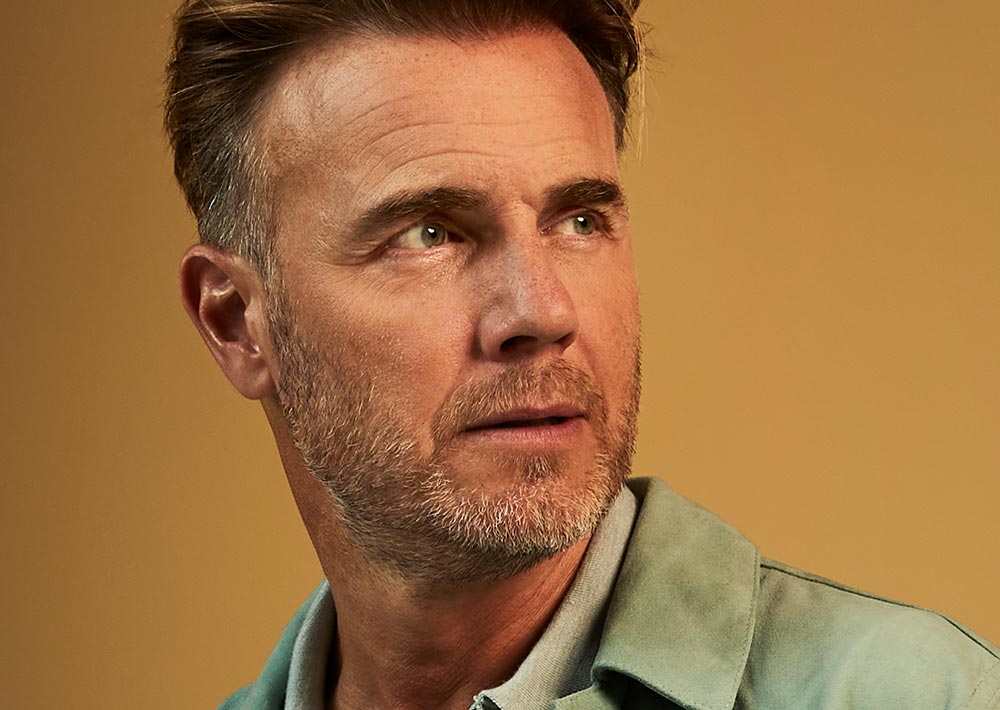

Gary Barlow in Songwriting Magazine: “It was never just a songwriting ambition for me, it was the whole thing.”
Looking beyond chart success, the Take That songwriter shares lessons on craft, collaboration and creative resilience built over decades worldwide
Editor’s Note: Originally published in Songwriting Magazine Winter 2020 – republished to coincide with the 2026 Take That Netflix documentary
In September 1989, Manchester-based manager Nigel Martin-Smith decided to create a British male vocal singing group in the vein of New Kids On The Block, and was introduced to a young singer-songwriter called Gary Barlow. The prodigal 15-year-old had already been performing in working men’s clubs and impressed Martin-Smith with his catalogue of self-written material. A campaign to audition young men who could sing and dance, led to auditions where Howard Donald, Mark Owen, Robbie Williams and Jason Orange joined Gary to form Take That, and the following 30 years saw the group become one of the most successful boy bands of all time.
Now, Gary Barlow OBE is considered one of Britain’s greatest songwriters, after penning 14 No 1 singles, landing 24 Top 10 hits, winning six Ivor Novello awards, and selling more than 50 million records.
As well as continuing his parallel career as a solo artist, in recent years, Gary has become increasingly involved in musical theatre. He co-wrote 22 songs for a revamped version of Finding Neverland, which hit Broadway in 2015, before co-writing for The Girls and playing a pivotal role in the stage production based on the music of Take That, The Band.
In the pandemic-inflicted year of 2020, we enjoyed an in-depth call with Gary via Zoom…
First published in Songwriting Magazine Winter 2020
Think back to the very start of your life as a songwriter – what do you wish you had, or what do you wish you’d known back then?
“It was basically a geographical thing. I was born in Frodsham, which is a tiny little village in the middle of Cheshire, and I used to listen to the radio a lot, trying to desperately decipher how they were writing and how they were making these records. It was never just a songwriting ambition for me, it was the whole thing. And I’m like that when I’m writing songs: I hear everything as I’m writing it. When I hear the chorus, I hear what the strings should be doing and how the piano should be voiced, and I like to be able to input that as I’m writing the song. I think it’s all part and parcel, and it will often change as the song evolves and other people get involved, but I think that in the initial birth hour of a song – when you’re hearing it fresh – you’ve got to input everything you can onto the screen.
“Coming back to your question, I wish I’d had YouTube, where I could have gone: where’s the best string library? Where’s the best, whatever… The other thing I wish I’d had was access to other people like me. Because now I have music students and a little music team in 24/7, working with me.”
A magazine to keep. An archive to explore.
Get the latest edition, 40+ back issues, 3,200+ website articles and expert insights for songwriters
Are they students that you’re mentoring?
“Well, it’s a 50/50 thing, it’s a two-way street. If the energy is only going one way then that’s not good for anyone. So the energy I put in, I want it back. I did come to London a little bit when I was like 16 years old and I got to look around studios, but only for an hour at a time – I got to look at the people working, wishing I was there. Instead, it was a very insular education I had of listening to records, sitting with a four-track and not knowing really what to do. So it was a different way of learning – very much self-taught.”
So, who would you have liked to have as a mentor?
“The person I still love to just go to dinner with, or just go and get a coffee with, is Trevor Horn. But there are loads of people like that, and what you often find is that these guys who have been there and done it, they love to talk about it. We’re all fascinated by it, the magic never dies. And so we love talking about it. We love talking about all the stuff that no one else is interested in.”

We read that you love to geek out over studio gear and the sound engineering process. Do you have to guard against being distracted by production while you’re in that crucial “birth hour”, or do you allow yourself to go off on tangents?
“I think musical distractions are good…a walk outside is good. Phone calls aren’t good; they’re distracting in a different way. But let’s be honest, no one can sit from nine o’clock in the morning to six o’clock at night, writing all day. It’s impossible. So, the chance to work on the drums for a bit, and ‘clean your ears’, make a cup of tea, then listen back, and you know what’s wrong. Yeah, so breaks are useful. Also, I usually have a timer in my studio – set it at 20 minutes and do a guitar bit, then it’ll ring, and I’ll do something else. Because we’re only human, our ears can only stand so much.”
If we were a fly on the wall back when you were writing songs for Take That in the early days, what would we see? Were you tearing your hair out, poring over every note and line?
“I was already in my rhythm by the time I joined the band. Because I first went on stage and played keyboards when I was 11, so by the time I joined the band at 19 years old, I’d done thousands of gigs. Yeah, honestly, I mean, thousands – I used to sometimes play every night of the week. So by the time I joined the group, I was just wandering on stages, and it was just like I’m in the living room! On the flip side of that, because I was working in the evenings, I had all day to mess around in the studio. I used to have a big ghetto blaster and literally play and sing songs into it. And I’d be doing them in batches of 10 songs, and I had like 30 of these. I was writing every day, so when I joined the group, it was just a continuation of that. I’m thankful of that because a lot of artists become successful and then have to learn to write. That’s tricky. So it happened in the right order
for me.”

Gary Barlow and Dan Keen on writing ‘Ant & Dec’s Limitless Win’
EXCLUSIVE: The Take That songwriter and his producer reveal how they wrote ... Read More+How I wrote ‘Clementine’ by Mark Owen
The Take That superstar shares the story behind his solo song, inspired by ... Read More+Review: BBC Maestro Gary Barlow Songwriting course
Performing songwriter and regular Songwriting Magazine contributor Lisa Red... Read More+



Gary Barlow in Songwriting Magazine: “It’s gotta be fun. It should never feel like you’re pulling your hair out.”
So do you subscribe to Malcolm Gladwell’s 10,000 hours to mastery theory?
“I did more than 10,000, I promise you! You know, when I go on stage now, people there are watching, it’s Monday night, and you’re at the O2 or whatever. But what they’re seeing is, thousands of hours of experience, that’s the hidden thing. It’s taken me years to get to this, and be this comfortable being here. I think it’s the same with performing as it is with songwriting, I believe when you start in both of those, you’re impersonating someone else, or you’re emulating someone you love, or a sound you love, or a chord you’ve heard in another song, at some point. And if you’re lucky, you get your own voice. The songwriting happened quite quickly for me, but with the performing, it took years to feel like I was being myself. But it comes back to what you just said: when you do the hours, you find it eventually.”
What advice would you give to your younger self, or any inexperienced songwriters out there now?
“I’m not very good at looking back. I’m in a lovely place and it took all those ups and downs to get to here, really. But the one thing that I’d say to everyone – something I try and say all day long in my studio – is it’s gotta be fun. It should never feel like you’re pulling your hair out, or you’re pulling teeth. It’s got to be thrilling and enjoyable, and all high fives.”
Let’s talk about the new album. It’s been seven years since your last solo LP, but obviously, you’ve been keeping busy! Do you making conscious plans about your future releases or just focus on one at a time?
“I’m a devil for making plans. To be honest, it’s almost the worst character trait for me; I’m always planning, and it’s not always good. So when we did our tour last year with the band, it was our 30th year anniversary, so it was a bit like ‘the pressure’s off tour’, I called it. It was just a wholehearted celebration and I really promised myself right at the start: I’m not going to think of what’s next. Because as soon as I do, you know, ‘new’ and ‘next’ is always better than ‘now’. And so I really did, I was really present, every show, I was there was loving it. Literally, a day later, I got the album name: Music Played By Humans.
“I sort of worked out that I’ve done loads of albums with musicians on – 12- or 14-piece strings on one track, maybe a band of six on another, but I’d never done an album that’s bursting with musicians – sections, big band sections, orchestral sections, 60- or 70-piece. I thought, ‘Wow! That’s it then, that’s what I want to do.’ Now, as soon as you make that decision, as a writer, the keyboard is now a massive canvas, and I went off and wrote the album in about three months, because I knew what it was for. And that’s great. It doesn’t always happen like that, often you’re searching for ‘why?’ but I got it early on, and it really made the job easier.”
We wondered if the making of this album was affected by the pandemic and lockdown. When did you start writing?
“Last summer, so I was pretty much done with the writing by about October-November. We did our very last orchestral session two weeks before we went into lockdown, so it felt like someone was looking down and taking care of us, because it was such a relief to know it was done. Then we basically spent since then mixing, because we’ve had the time – it’s been lovely.”
The album is pretty eclectic. How conscious are you of the style of each song through the early part of the writing process? And when do you start thinking about potential collaborators?
“Well, I find that early on in the writing process, anything goes, and that’s lovely. That’s the best time. Then later on down the line, the album starts to take shape, and you go, ‘Hmm, we’re missing an up-tempo one,’ and that’s the point when I start searching for things and writing things especially for places on the record. But it’s not always that. In November, I was talking to Michael Bublé, with no idea of a collaboration, we’re just chatting, just catching up. He was on a world tour, and we’re just like, ‘We should do something,’ and the next day I got the first verse of Elita and sent it to him. It was only a piano, and then he sent it bac,k and he’d added a pre-chorus and a second verse for him to sing. So, you know, it just happens. We don’t phone each other up and say, ‘Ooh, shall we do a Latin-pop song together?’ Those opportunities fly past and you’ve got to grab them. And that’s what makes the 18-month period of making a record so exciting, you don’t know what’s going to happen. So that’s the thrill of making music.”
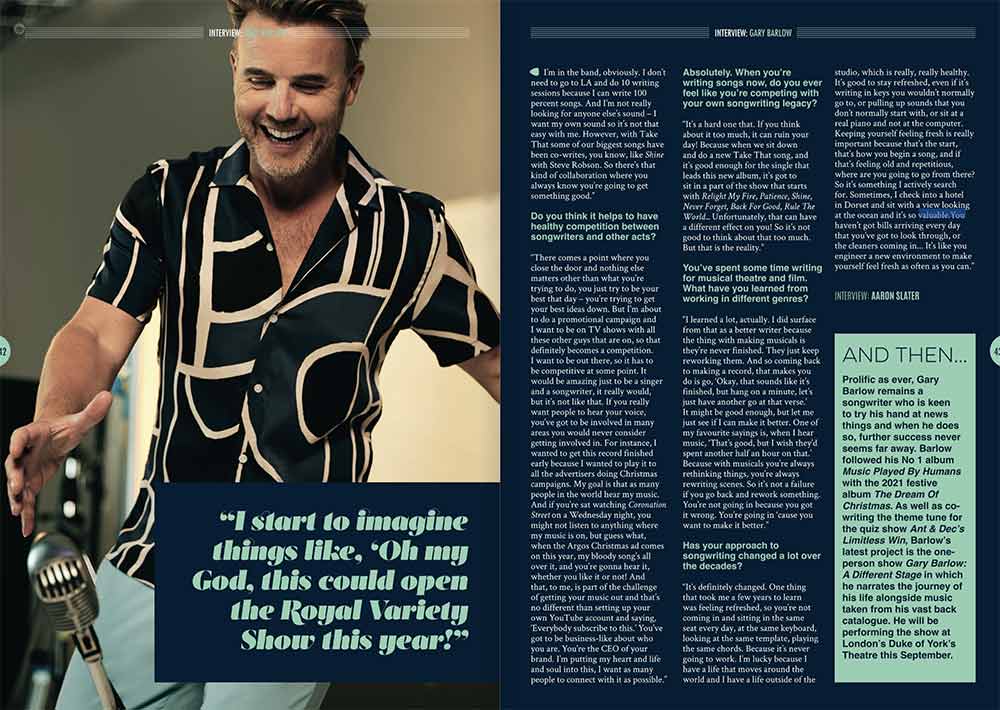
Gary Barlow in Songwriting Magazine: “I start to imagine things like, ‘Oh my God, this could open the Royal Variety Show this year!’”
When you’re writing those songs, are you thinking about how an audience might react, or are you allowing the song to just come out and then see where it goes?
“Yeah, you’ve got to forget about it. That’s hard. I can’t do that. I’ve got friends who do…‘Hey, I need a big climax of the movie,’ and they go and do it. I mean, that’s clever. However, when you’ve got a song like Incredible, it’s like, ‘Right, let’s dial up the fun here!’ and I start to imagine things like, ‘Oh my God, this could open the Royal Variety Show this year!’ So it’s hard at that point to then not imagine where it could fit in. At some point, they gather pace and become what they are.”
How do you choose collaborators, other than the situations where you just happen to bump into somebody?
“It’s a tricky one. My collaborations nowadays are usually for stage shows or film, TV. I collaborate when I’m in the band, obviously. I don’t need to go to LA and do 10 writing sessions because I can write 100 percent songs. And I’m not really looking for anyone else’s sound – I want my own sound, so it’s not that easy with me. However, with Take That, some of our biggest songs have been co-writes, you know, like Shine with Steve Robson. So there’s that kind of collaboration where you always know you’re going to get something good.”
Do you think it helps to have healthy competition between songwriters and other acts?
“There comes a point where you close the door, and nothing else matters other than what you’re trying to do, you just try to be your best that day – you’re trying to get your best ideas down. But I’m about to do a promotional campaign, and I want to be on TV shows with all these other guys that are on, so that definitely becomes a competition. I want to be out there, so it has to be competitive at some point. It would be amazing just to be a singer and a songwriter, it really would, but it’s not like that. If you really want people to hear your voice, you’ve got to be involved in many areas you would never consider getting involved in. For instance, I wanted to get this record finished early because I wanted to play it to all the advertisers doing Christmas campaigns. My goal is that as many people in the world hear my music. And if you’re sat watching Coronation Street on a Wednesday night, you might not listen to anything where my music is on, but guess what, when the Argos Christmas ad comes on this year, my bloody song’s all over it, and you’re gonna hear it, whether you like it or not! And that, to me, is part of the challenge of getting your music out and that’s no different than setting up your own YouTube account and saying, ‘Everybody subscribe to this.’ You’ve got to be business-like about who you are. You’re the CEO of your brand. I’m putting my heart and life and soul into this, I want as many people to connect with it as possible.”
Absolutely. When you’re writing songs now, do you ever feel like you’re competing with your own songwriting legacy?
“It’s a hard one, that. If you think about it too much, it can ruin your day! Because when we sit down and do a new Take That song, and it’s good enough for the single that leads this new album, it’s got to sit in a part of the show that starts with Relight My Fire, Patience, Shine, Never Forget, Back For Good, Rule The World… Unfortunately, that can have a different effect on you! So it’s not good to think about that too much. But that is the reality.”
You’ve spent some time writing for musical theatre and film. What have you learned from working in different genres?
“I learned a lot, actually. I did surface from that as a better writer because the thing with making musicals is they’re never finished. They just keep reworking them. And so coming back to making a record, what that makes you do is go, ‘Okay, that sounds like it’s finished, but hang on a minute, let’s just have another go at that verse.’ It might be good enough, but let me just see if I can make it better. One of my favourite sayings is, when I hear music, ‘That’s good, but I wish they’d spent another half an hour on that.’ Because with musicals, you’re always rethinking things, you’re always rewriting scenes. So it’s not a failure if you go back and rework something. You’re not going in because you got it wrong. You’re going in ‘cause you want to make it better.”
Has your approach to songwriting changed a lot over the decades?
“It’s definitely changed. One thing that took me a few years to learn was feeling refreshed, so you’re not coming in and sitting in the same seat every day, at the same keyboard, looking at the same template, playing the same chords. Because it’s never going to work. I’m lucky because I have a life that moves around the world, and I have a life outside of the studio, which is really, really healthy. It’s good to stay refreshed, even if it’s writing in keys you wouldn’t normally go to, or pulling up sounds that you don’t normally start with, or sit at a real piano and not at the computer. Keeping yourself feeling fresh is really important because that’s the start, that’s how you begin a song, and if that’s feeling old and repetitious, where are you going to go from there? So it’s something I actively search for. Sometimes, I check into a hotel in Dorset and sit with a view looking at the ocean, and it’s so valuable. You haven’t got bills arriving every day that you’ve got to look through, or the cleaners coming in… It’s like you engineer a new environment to make yourself feel fresh as often as you can.”
Gary’s solo album Music Played By Humans is out now. For more info, pop along to garybarlow.com
First published in Songwriting Magazine Winter 2020
More Like This
Interview: Mark Owen
In 2022, with a triumphant new solo album under his belt, the unassuming Ta... Read More+Gary Barlow and Dan Keen on writing ‘Ant & Dec’s Limitless Win’
EXCLUSIVE: The Take That songwriter and his producer reveal how they wrote ... Read More+How I wrote ‘Clementine’ by Mark Owen
The Take That superstar shares the story behind his solo song, inspired by ... Read More+Review: BBC Maestro Gary Barlow Songwriting course
Performing songwriter and regular Songwriting Magazine contributor Lisa Red... Read More+







More Like This